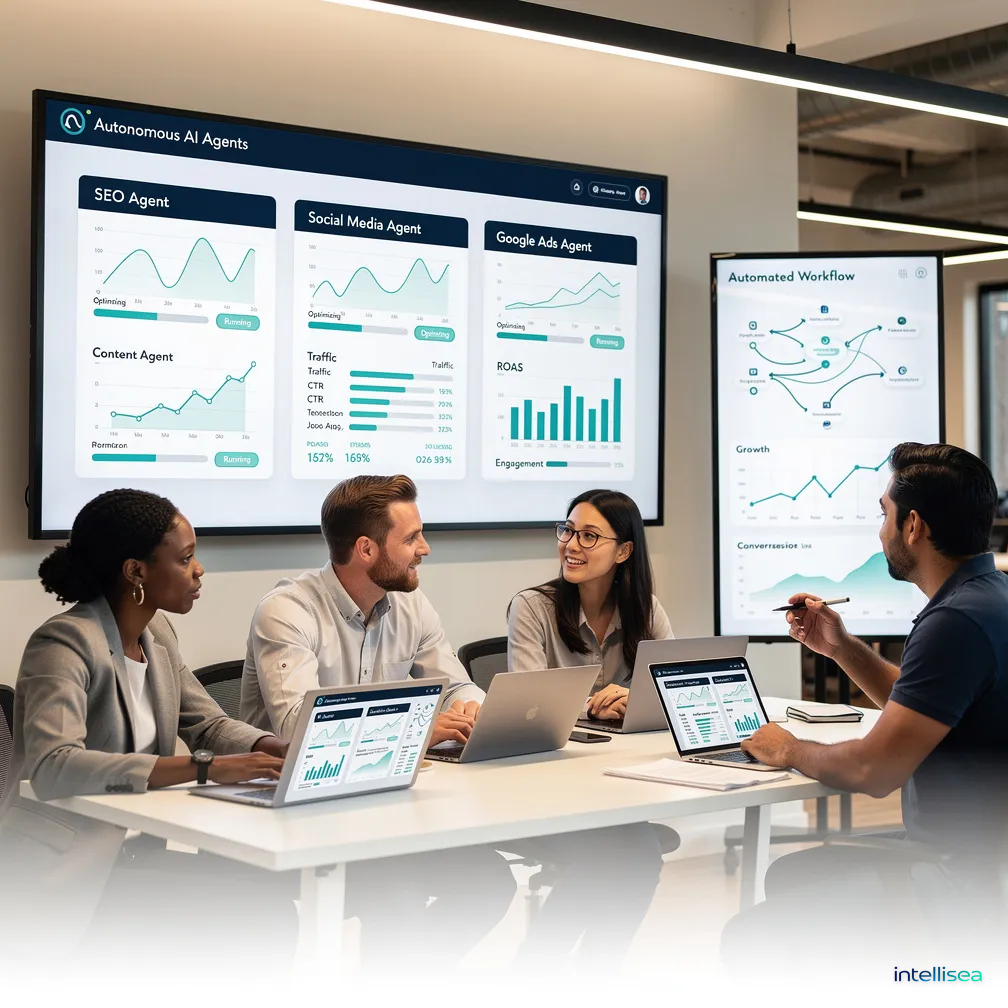
If you're searching for the best AI tools for digital marketing right now, you've probably noticed something: there are hundreds of them. Content generators, SEO optimizers, PPC managers, social media schedulers, analytics dashboards. Each one promises to revolutionize your marketing. Each one requires you to learn a new interface, integrate another platform, and somehow orchestrate all these tools into a coherent strategy.
Here's the uncomfortable truth most AI tool vendors won't tell you: having more tools doesn't necessarily make you more effective. In fact, it often creates a new problem — tool sprawl. You're spending more time managing your AI marketing tools than actually marketing.
But what if the entire paradigm is shifting? What if the future of AI powered marketing isn't about collecting the best individual tools, but about deploying autonomous agents that actually execute your strategy across every channel, 24/7, without you having to orchestrate the symphony?
That's exactly what's happening in 2026, and it's why understanding the difference between traditional AI tools for digital marketing and agentic AI marketing platforms like Intellisea matters more than ever.
The Current Landscape of AI Marketing Tools Tools
Let's start by acknowledging what's already out there, because the current generation of AI marketing tools has genuinely transformed how digital marketing works.
Content Creation Tools have become remarkably sophisticated. Platforms powered by large language models can generate blog posts, social media captions, email sequences, and ad copy in seconds. They've democratized content creation, allowing small teams to produce volumes that once required entire content departments.
SEO and Research Tools now leverage AI to analyze search intent, identify keyword opportunities, predict ranking difficulty, and even suggest content structures that align with what search engines reward. They've made technical SEO more accessible and strategic SEO more data-driven.
PPC and Ad Management Platforms use machine learning to optimize bids, test ad variations, and allocate budget across campaigns. They can process signals and make adjustments faster than any human team, improving PPC ROI incrementally across thousands of daily micro-decisions.
Social Media Management Tools employ AI to suggest optimal posting times, generate hashtags, create variations of content for different platforms, and even respond to common customer inquiries through chatbots.
Analytics and Attribution Platforms apply AI to make sense of cross-channel data, identify patterns humans might miss, and predict which data-driven marketing activities will drive the most value. For agencies building their entire strategy around this approach, data-driven digital marketing has become the standard rather than the exception.
These are genuinely powerful capabilities. The best ai tools for digital marketing have made individual marketing functions more efficient, more scalable, and more data-informed than ever before.
So what's the problem?
Why Standalone AI Tools Aren't Enough Anymore
The problem isn't with the tools themselves. It's with the model of how they work — and more importantly, who does the work.
Traditional AI tools for digital marketing are assistants. They're powerful assistants, but they're still waiting for you to tell them what to do. You generate the content, but you still need to decide what content to create. You optimize the PPC campaign, but you still need to define the strategy. You analyze the data, but you still need to interpret what actions to take.
In other words, you're still the strategist, the executor, the coordinator, and the decision-maker. The AI just makes each individual task faster.
This creates several challenges that become more acute as your marketing grows:
Integration Overhead: Each tool lives in its own silo. Your content tool doesn't talk to your SEO tool. Your PPC platform doesn't coordinate with your social strategy. You become the integration layer, manually connecting insights from one tool to actions in another.
Strategic Fragmentation: When your marketing is split across multiple AI tools, your strategy fragments with it. You might be optimizing each channel individually, but are those channels working together toward unified business goals? Usually not, because no single tool is responsible for the whole.
Constant Context Switching: Managing multiple AI marketing tools means constantly shifting between platforms, interfaces, and mental models. The cognitive load doesn't decrease — it just changes form.
Execution Bottleneck: You remain the bottleneck. Even with AI assistance, you can only review so many content pieces, approve so many campaigns, and make so many strategic decisions in a day. Your marketing moves at the speed of your attention.
This is where the fundamental limitation reveals itself: traditional AI tools for digital marketing make you faster at doing marketing, but they don't actually do marketing for you.
What Makes Agentic AI Marketing Tools Different
Agentic AI represents a fundamental shift in how artificial intelligence operates in marketing contexts. Where traditional AI tools are reactive and task-specific, agentic AI marketing platforms are proactive and goal-oriented.
Think about the difference this way: a traditional AI tool is like a sophisticated calculator. You input the problem, it processes according to its programming, and it gives you an answer. An agentic AI, by contrast, is more like a team member. You give it objectives and context, and it figures out what needs to be done, executes those tasks, monitors the results, and adjusts its approach based on what's working.
Agentic AI systems have several defining characteristics that distinguish them from conventional AI marketing tools:
Autonomous Decision-Making: Rather than waiting for prompts, agentic AI can make strategic decisions within defined parameters. It doesn't just suggest what content to create — it decides what content will best serve your goals right now, creates it, and publishes it.
Multi-Step Reasoning: Agentic AI can break down complex objectives into sequences of actions. If the goal is to increase qualified leads from a specific industry segment, it can devise a multi-channel approach, execute each component, and coordinate the timing for maximum impact.
Cross-Channel Coordination: Because agentic AI operates at the strategic level rather than the tool level, it naturally coordinates across channels. Your SEO content strategy informs your social promotion, which feeds into your email nurture sequences, which aligns with your PPC targeting — all orchestrated by the same intelligence.
Continuous Learning and Adaptation: Agentic AI doesn't just execute a plan and stop. It monitors performance across all activities, identifies what's working and what isn't, and continuously refines its approach without requiring you to log in and make manual adjustments.
Context Retention: Unlike standalone tools where you lose context when switching between platforms, agentic AI maintains complete context about your business, your audience, your goals, and your entire marketing history. Every decision is informed by everything that's happened before.
This isn't just incremental improvement. It's a different category of capability entirely — one that shifts AI powered marketing from assistance to autonomy.
How Intellisea Is Driving the Future of AI Marketing Tools Tools
This is where Intellisea enters the picture, not as another tool in your marketing stack, but as a fundamentally different approach to what an AI marketing agency or platform can be.
Intellisea has built what they call an agentic AI marketing platform — a system of autonomous AI agents that don't just help you do marketing, but actually execute comprehensive marketing strategies across all digital channels.
Here's how it works in practice:
Instead of logging into multiple AI tools each morning to generate content, optimize campaigns, and analyze results, you work with Intellisea to define your business objectives, target audience, brand voice, and strategic parameters. From there, Intellisea's autonomous agents take over the execution.
The Content Agent doesn't wait for you to assign topics. It analyzes search trends, monitors your competitive landscape, identifies content gaps in your funnel, and creates the content your strategy needs right now — blog posts, social updates, email sequences, landing pages — all while maintaining your brand voice and optimizing for search intent.
The SEO Agent doesn't just suggest keywords. It continuously monitors your rankings, identifies opportunities, coordinates with the content agent to target those opportunities, builds internal linking structures, and adapts to algorithm changes in real-time.
The Paid Media Agent doesn't just optimize existing campaigns. It identifies new audience segments worth testing, creates ad variations, allocates budget based on performance across the entire funnel, and coordinates with organic efforts to avoid audience overlap and maximize efficiency.
The Social Agent doesn't just schedule posts. It monitors conversations relevant to your brand, engages with potential customers, amplifies your best-performing content, and adapts your social media strategy based on what's resonating with each audience segment.
The Analytics Agent doesn't just report metrics. It identifies patterns across all marketing activities, surfaces insights that require strategic attention, and automatically implements optimizations for routine decisions.
The crucial difference is that these aren't separate tools you're juggling. They're specialized agents within a unified intelligence that coordinates everything toward your business objectives. They work together, share context, and execute a coherent strategy while you focus on higher-level decisions and business growth.
This is what makes Intellisea's approach the evolution beyond traditional AI tools for digital marketing. It's not about having the best individual tools. It's about having an autonomous system that actually does the work of marketing, continuously and intelligently, across every channel.
What This Means for Marketers in 2026 and Beyond
If you're a business owner, marketing director, or digital marketing professional trying to stay competitive, understanding this shift from tools to agents matters enormously.
The companies that will win in the coming years aren't necessarily those with the biggest marketing teams or the longest list of AI marketing tools. They're the ones who can execute strategy consistently, adapt quickly to changing conditions, and maintain coordination across increasingly complex channel ecosystems.
That's extraordinarily difficult to do with human teams alone — there simply aren't enough hours in the day. And it's also difficult to do with traditional AI tools, because you're still the coordinator, still the bottleneck, still the one who has to connect everything together.
Agentic AI marketing platforms like Intellisea change the equation. They give smaller teams the execution capacity of much larger organizations. They give strategic thinkers the ability to focus on strategy rather than drowning in tactical execution. They give businesses the ability to be truly omnichannel without requiring an army of specialists.
This doesn't mean human marketers become obsolete. Quite the opposite. It means human marketers can finally focus on what humans do best — creative thinking, strategic positioning, understanding customer psychology, building brand identity, and making the judgment calls that require genuine business context and intuition.
The autonomous agents handle what AI does best — processing vast amounts of data, maintaining consistency across thousands of touchpoints, executing complex multi-step workflows, and optimizing performance through continuous testing and adaptation.
It's not about replacing marketers. It's about augmenting them with autonomous execution capacity that operates at a scale and consistency that was previously impossible.
Choosing Your Path Forward
So where does this leave you in your search for the best AI tools for digital marketing?
You have two paths forward. The first is to continue accumulating specialized AI marketing tools — a content generator here, an SEO platform there, a PPC optimizer, a social scheduler, an analytics dashboard. You'll get better at each individual function, but you'll also spend increasing amounts of time and energy being the integration layer that holds it all together.
The second path is to recognize that the paradigm is shifting from tools to agents, from assistance to autonomy, from helping you do marketing to actually doing marketing. This path means working with platforms like Intellisea that offer agentic AI marketing — autonomous agents that execute comprehensive strategies across all channels while you focus on the strategic decisions that truly require human judgment.
Neither path is wrong. But they lead to very different places in terms of scalability, efficiency, and competitive advantage. If you're weighing your options, understanding how to choose the right digital marketing agency can help you evaluate which approach fits your business stage.
If you're still in the early stages of digital marketing, traditional AI tools for digital marketing might be sufficient. They'll help you do more with less and learn the fundamentals of each channel.
But if you're at the point where your marketing complexity is overwhelming your capacity — where you know what needs to be done but can't execute it all consistently — then agentic AI marketing isn't just an advantage. It's becoming essential.
Intellisea represents where AI powered marketing is heading: toward autonomous execution, strategic coordination, and continuous optimization across every digital channel. Not as a collection of tools you manage, but as an intelligent system that actually runs your marketing while you run your business.
The question isn't whether this shift will happen. It's already happening. The question is whether you'll be ahead of it or scrambling to catch up.
Ready to see what autonomous AI agents can do for your marketing? Visit Intellisea's AI marketing platform to learn how agentic AI is transforming digital marketing from a collection of tools into a coordinated system that executes strategy 24/7 across every channel. The future of AI marketing tools isn't about having more tools — it's about having intelligence that actually works for you.
Related reading
- the Intellisea technology stack
- The getting started guide to AI marketing
- Best AI Tools for Digital Marketing Agencies in 2026 [Updated]
- AI-Powered Tools for Digital Marketing: The Complete Guide to Smarter Campaigns