The marketing agency landscape is undergoing a fundamental shift. As artificial intelligence matures from experimental technology to operational backbone, a new category of agency has emerged: the AI powered marketing agency. These agencies don't simply use AI as an add-on — they build their entire service delivery model around machine learning, predictive analytics, and autonomous optimization systems that operate continuously across every marketing channel.
For mid-market companies evaluating agency partners, understanding what separates a genuinely AI-powered agency from one that merely mentions AI in its pitch deck is critical. The difference directly impacts campaign performance, speed of optimization, and the return on every marketing dollar spent.
What Makes an Agency AI-Powered?
The term "AI powered marketing agency" gets applied broadly, but genuine AI integration goes far beyond using ChatGPT for copywriting drafts or running Google's Smart Bidding on ad campaigns. A truly AI-powered agency embeds artificial intelligence into its operational core — the systems that analyze data, identify opportunities, make optimization decisions, and execute changes across client campaigns.
This distinction matters because surface-level AI adoption produces surface-level results. When AI is limited to content generation or basic automation, the strategic layer — where the highest-value decisions happen — remains entirely manual and constrained by human bandwidth. An AI powered marketing agency uses machine learning at the strategic layer: identifying which channels deserve budget reallocation, predicting which content topics will drive qualified traffic before they trend, and detecting performance anomalies hours or days before scheduled human review would catch them.
The practical difference for clients is speed and precision. Traditional agencies operate on weekly or monthly optimization cycles. AI-powered agencies operate on continuous cycles where algorithms monitor, analyze, and adjust in real time — escalating to human strategists only when decisions require creative judgment or client-specific context that the system hasn't yet learned.
Core Capabilities of an AI Powered Marketing Agency
Understanding the specific capabilities that AI enables helps cut through marketing jargon and evaluate what an agency can actually deliver.
Predictive campaign planning is one of the most valuable capabilities. Rather than building campaigns based on historical benchmarks and educated assumptions, AI-powered agencies use machine learning models trained on cross-client data to forecast campaign outcomes before launch. These models predict click-through rates, conversion rates, cost per acquisition, and revenue impact across different budget scenarios — enabling clients to make informed investment decisions rather than expensive experiments.
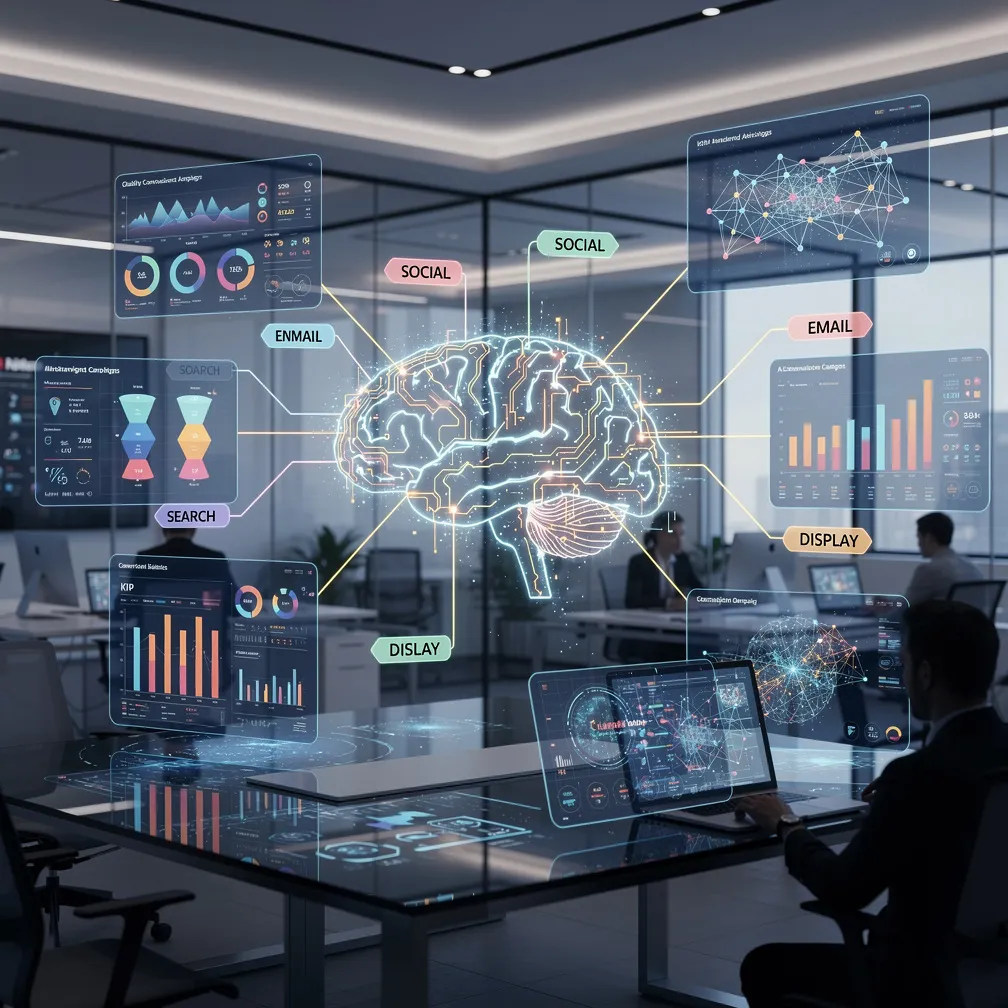
Automated cross-channel optimization breaks down the silos that plague multi-channel marketing. When AI systems have visibility across SEO, paid search, paid social, email, and content simultaneously, they can identify opportunities that channel-specific teams miss. A spike in organic traffic for a keyword cluster might trigger reduced PPC spend on those terms and reallocation to higher-intent queries where organic coverage is weak. This cross-channel intelligence happens continuously, not during quarterly strategy reviews.
Personalization at scale becomes practical when AI handles the complexity. Creating personalized content, ad creative, and landing page experiences for dozens of audience segments is prohibitively labor-intensive for human teams. AI systems generate, test, and optimize personalized variations automatically — matching messaging, imagery, and offers to individual user behavior patterns and intent signals.
Anomaly detection and proactive response transforms agencies from reactive to proactive. AI monitoring systems flag unusual patterns — traffic drops, conversion rate shifts, competitor moves, algorithm updates — within minutes rather than days. This early warning system means problems are addressed before they become expensive and opportunities are captured before competitors react. For a comprehensive breakdown of the specific tools driving these capabilities, explore our complete guide to AI-powered tools for digital marketing.
Traditional vs. AI-Powered Agency Services
The contrast between traditional and AI-powered agency operations becomes clearest when examining specific service areas:
In SEO, traditional agencies conduct periodic keyword research, publish content on editorial calendars, and review rankings monthly. An AI-powered agency continuously monitors search landscape changes, identifies emerging keyword opportunities as search volume patterns shift, optimizes existing content based on real-time ranking factor analysis, and prioritizes technical fixes by predicted impact rather than crawl order.
In paid advertising, the gap is even more pronounced. Traditional agencies set up campaigns, monitor performance weekly, and make manual bid adjustments. AI-powered agencies deploy algorithms that adjust bids hundreds of times daily, automatically shift budget between campaigns based on real-time conversion data, generate and test ad variations continuously, and predict audience fatigue before performance declines.
In content marketing, traditional agencies follow editorial calendars built on keyword research and brand messaging. AI-powered agencies supplement this with predictive topic modeling that identifies content opportunities based on search trend trajectories, competitive content gaps, and audience engagement patterns — then optimize published content dynamically based on performance data.
In analytics and reporting, the difference is transformative. Traditional agencies deliver monthly reports that describe what happened. AI-powered agencies deliver continuous intelligence that explains why metrics changed, predicts where they're heading, and recommends specific actions — often executing routine optimizations automatically before the report is even generated.
The Agentic AI Advantage: Autonomous Multi-Channel Orchestration
The most advanced AI powered marketing agency model uses agentic AI — systems where specialized AI agents operate autonomously within defined parameters, collaborating with each other across marketing channels. This represents a fundamental leap beyond using AI as a tool within human-directed workflows.
In an agentic framework, an SEO agent monitors rankings, technical health, and content performance continuously. When it identifies a high-value keyword opportunity, it doesn't just flag it for a human — it coordinates with a content agent to evaluate whether existing content can be optimized or new content is needed, shares the intelligence with a PPC agent to adjust paid coverage during the organic growth period, and feeds the data into an analytics agent that updates attribution models and forecasts.
This coordination happens without human intervention for routine decisions, which means optimization cycles that previously took weeks now happen in hours. Human strategists focus on high-level direction, creative vision, and client relationships rather than operational execution — the work that actually requires human judgment.
For clients, the agentic AI advantage manifests as faster results, more efficient spend, and strategies that adapt to market conditions in real time rather than at the pace of scheduled strategy meetings.
How to Evaluate an AI Marketing Agency
With every agency now claiming AI capabilities, distinguishing genuine AI-powered operations from marketing buzzwords requires targeted evaluation:
- Ask about proprietary technology — Agencies with genuine AI capabilities have built or deeply customized their technology stack. If they're exclusively using the same third-party tools available to every agency, the AI advantage is minimal.
- Request specific examples of autonomous optimization — Ask for cases where their AI systems identified and acted on opportunities without human initiation. The specificity of their answer reveals the depth of their AI integration.
- Understand their data architecture — True AI-powered agencies have unified data systems that connect insights across channels. If their SEO team uses different data than their PPC team, the AI integration is surface-level.
- Evaluate the human-AI balance — The best agencies are transparent about what AI handles versus what human strategists direct. Be wary of agencies that either overstate AI autonomy or understate it — both suggest they don't fully understand their own systems.
- Look for continuous optimization evidence — Ask how frequently their systems make adjustments and how they report on AI-driven changes. Monthly optimization reports suggest human-directed workflows with AI tools, not AI-powered operations.
Frequently Asked Questions
What is an AI powered marketing agency?
An AI powered marketing agency integrates artificial intelligence technologies like machine learning, natural language processing, and predictive analytics into its core service delivery. Rather than using AI as an occasional tool, these agencies build their optimization workflows, data analysis, and campaign management around AI systems that operate continuously across all marketing channels.
How does an AI marketing agency differ from a traditional agency?
AI marketing agencies use machine learning and automation to analyze data, optimize campaigns, and personalize content at speeds and scales impossible for traditional agencies. They combine human strategic thinking with AI execution capabilities for faster, more accurate results. The key difference is continuous optimization versus periodic human review cycles.
Are AI-powered agency services more expensive?
Not necessarily. While some AI capabilities require initial investment, they often reduce long-term costs by automating repetitive tasks and improving efficiency. Many mid-market businesses find AI-powered agencies deliver better ROI despite similar or even lower fees than traditional agencies — because AI eliminates the inefficiency that manual processes introduce.
Will AI replace human marketers at agencies?
No. Effective AI-powered agencies use artificial intelligence to augment human capabilities, not replace them. AI handles data analysis, routine optimization, and execution at scale while humans provide creative direction, strategic thinking, client relationship management, and the nuanced judgment that algorithms cannot replicate.
How can I evaluate an agency's AI capabilities?
Ask about proprietary AI technologies versus third-party tools, request case studies showing AI-driven results with specific metrics, inquire about their data practices and AI transparency, and understand how they integrate human expertise with AI systems. Genuine AI capability shows in specificity — vague claims about "leveraging AI" without operational detail are a red flag.
The Future of Agency Marketing Is Autonomous
The shift toward AI-powered agency services isn't a trend — it's a structural change in how marketing gets done. Agencies that embed AI into their operational core deliver measurably better outcomes: faster optimization, more precise targeting, earlier opportunity identification, and more efficient budget utilization.
For mid-market companies evaluating agency partners, the question isn't whether AI matters — it's whether the agency you're considering has genuinely built its operations around AI or simply added the term to its website. The distinction determines whether you get a true AI powered marketing agency advantage or just a traditional agency with a modern label.