
The landscape of search engine optimization has fundamentally transformed with the integration of artificial intelligence. What once required countless hours of manual analysis, guesswork, and trial-and-error can now be streamlined through AI-powered SEO strategies that deliver faster, more accurate results. For business owners and marketing professionals, understanding how to use AI for SEO isn't just an advantage—it's becoming essential for staying competitive in an increasingly sophisticated digital marketplace.
This practical guide walks you through a comprehensive AI SEO strategy, breaking down the implementation process into five actionable steps. Whether you're managing a small business website or overseeing enterprise-level digital marketing, these techniques will help you leverage AI SEO tools to improve rankings, drive organic traffic, and maximize your return on investment.
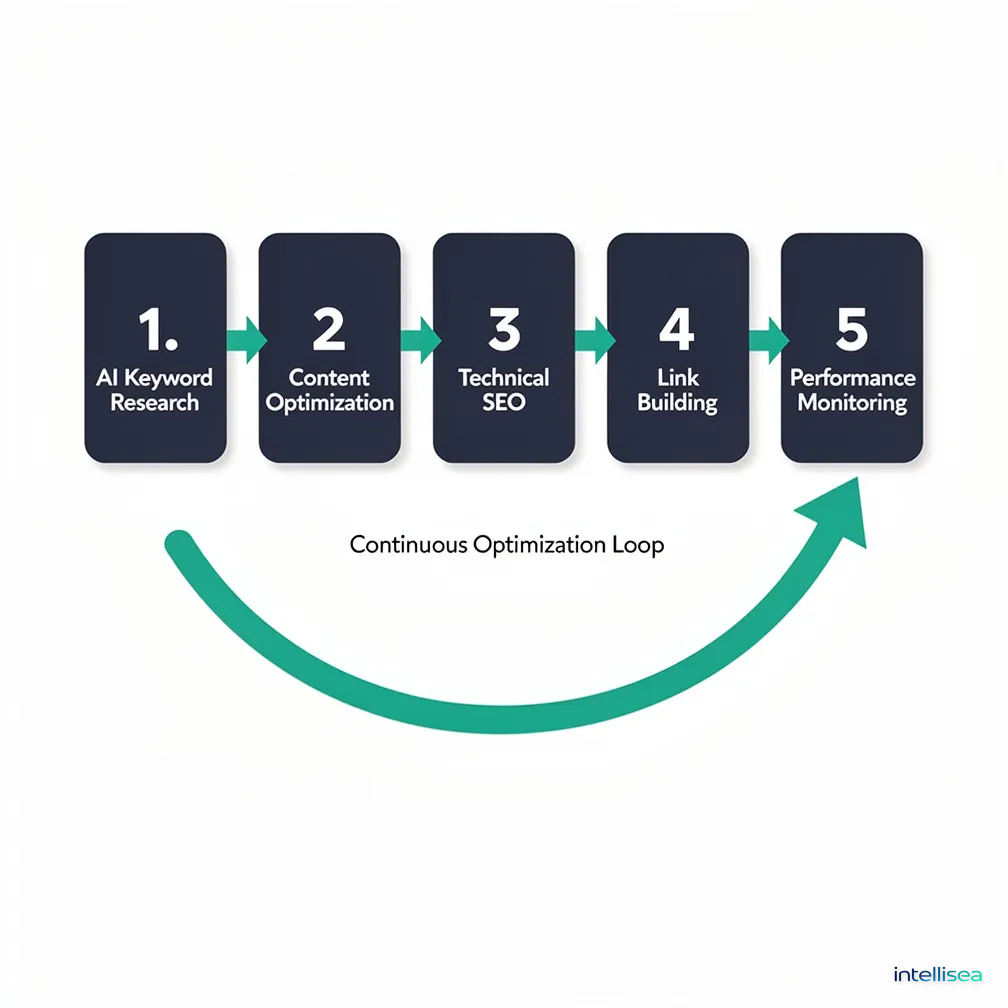
The 5-step AI SEO implementation process — a continuous optimization cycle
Step 1: AI-Powered Keyword Research
What to Do
Traditional keyword research involves manually analyzing search volumes, competition levels, and user intent. AI-driven SEO transforms this process by analyzing massive datasets to identify high-opportunity keywords that your competitors might miss. Start by defining your core business offerings and target audience, then use AI tools to generate comprehensive keyword clusters that align with different stages of the buyer journey.
Focus on identifying long-tail keywords with commercial intent, question-based queries that match voice search patterns, and semantic keyword variations that search engines now prioritize. AI algorithms can process search trends across millions of queries to reveal emerging opportunities before they become saturated. For a deeper dive into organizing these keywords effectively, see our guide on how to use AI for SEO keyword clusters.
Which AI Capabilities to Use
Natural language processing enables AI systems to understand context and user intent behind search queries, moving beyond simple keyword matching. Machine learning algorithms analyze historical search data to predict which keywords will generate the most qualified traffic for your specific industry and business model.
Leverage predictive analytics to forecast seasonal trends and emerging topics in your niche. AI-powered clustering capabilities automatically group related keywords into topical themes, helping you build comprehensive content strategies rather than targeting isolated terms. Sentiment analysis tools can also identify the emotional context behind searches, allowing you to craft content that resonates with user needs.
Practical Tips
Begin with seed keywords that represent your core offerings, then allow AI tools to expand these into comprehensive keyword families. Don't ignore keywords with lower search volumes—AI can identify conversion potential that raw numbers don't reveal. Cross-reference AI recommendations with your existing analytics data to identify gaps in your current content coverage.
Create separate keyword lists for different content types: informational blog posts, product pages, and conversion-focused landing pages. Use AI to analyze your competitors' ranking keywords and identify content gaps where you can establish authority. Remember that AI for SEO works best when you provide clear business context—the algorithms need to understand your unique value proposition to deliver truly relevant recommendations.
Step 2: Content Optimization with AI
What to Do
Once you've identified target keywords, AI-powered SEO tools can optimize your content for both search engines and human readers. This involves analyzing top-ranking content to understand what search engines reward, then creating comprehensive, well-structured content that matches or exceeds those standards.
Use AI to evaluate content depth, readability, semantic relevance, and topical authority. The goal isn't to copy competitors but to understand the content characteristics that signal quality to search algorithms. AI can identify missing subtopics, suggest optimal content length, and recommend internal linking opportunities that strengthen your site's topical authority.
Which AI Capabilities to Use
Natural language generation assists with content creation, though human oversight remains essential for maintaining brand voice and accuracy. Semantic analysis tools evaluate how well your content covers a topic comprehensively, identifying related concepts and entities you should include to demonstrate expertise.
AI-driven readability analyzers assess sentence structure, vocabulary complexity, and content flow to ensure your writing engages your target audience. Entity recognition capabilities help you incorporate relevant people, places, organizations, and concepts that search engines use to understand content context. These AI SEO tools can also optimize meta descriptions, title tags, and header structures for maximum click-through rates.
Practical Tips
Don't rely solely on AI-generated content—use it as a foundation that human writers refine and enhance with unique insights and brand personality. Focus on creating content that serves user intent first, with optimization as a secondary consideration. Search engines increasingly reward content that genuinely answers questions and provides value.
Implement AI recommendations for content structure, including optimal header hierarchies and paragraph lengths that improve both SEO and user experience. Use AI to identify opportunities for rich media integration, such as images, videos, and infographics that enhance engagement. Regularly update existing content based on AI analysis of performance data and changing search trends. This approach to AI-driven SEO ensures your content remains competitive as algorithms evolve. For a closer look at how AI handles the full content pipeline, explore our guide on AI agents for content creation.
Step 3: Technical SEO Automation
What to Do
Technical SEO forms the foundation that allows search engines to effectively crawl, index, and rank your content. AI automation can continuously monitor your website for technical issues that impact performance, from broken links and crawl errors to page speed problems and mobile usability issues.
Implement automated systems that scan your site architecture, identify duplicate content, optimize XML sitemaps, and ensure proper schema markup implementation. AI can also monitor Core Web Vitals metrics and automatically flag pages that fail to meet performance thresholds, allowing you to address issues before they impact rankings.
Which AI Capabilities to Use
Machine learning algorithms can predict which technical issues will have the greatest impact on your rankings, helping you prioritize fixes based on potential ROI. Automated crawling systems continuously monitor your site just as search engine bots do, identifying indexation problems, redirect chains, and orphaned pages.
AI-powered log file analysis reveals how search engines actually interact with your site, identifying crawl budget waste and pages that search bots struggle to access. Pattern recognition capabilities can detect technical SEO issues across large websites that would be impossible to identify manually, from inconsistent structured data to systematic canonicalization problems.
Practical Tips
Set up automated alerts that notify you immediately when critical technical issues arise, such as server errors or sudden drops in indexed pages. Don't wait for manual audits—continuous monitoring prevents small problems from becoming ranking disasters. Integrate your AI SEO tools with your development workflow so technical recommendations can be implemented quickly.
Focus automation on repetitive tasks like monitoring page speed scores, checking for broken links, and validating schema markup across your site. Use AI to analyze the relationship between technical metrics and actual ranking performance, identifying which technical factors matter most for your specific site. Remember that technical SEO automation complements human expertise—complex architectural decisions still require strategic thinking that AI cannot fully replace. See how autonomous agents handle this end-to-end in our article on AI agents for SEO automation.
Step 4: AI-Driven Link Building Strategy
What to Do
Link building remains a crucial ranking factor, and AI-powered SEO approaches can make this challenging process more efficient and effective. Use AI to identify high-quality link opportunities, analyze competitor backlink profiles, and predict which outreach strategies will generate the best results for your industry.
Focus on building relationships with authoritative sites in your niche rather than pursuing quantity over quality. AI can help you identify websites whose audience aligns with your target market, discover broken link opportunities, and find unlinked brand mentions that can be converted into backlinks through simple outreach.
Which AI Capabilities to Use
Natural language processing analyzes content across millions of websites to identify potential link partners whose topics align with yours. Predictive modeling assesses the quality and relevance of potential backlinks, helping you avoid low-value or potentially harmful links that could trigger penalties.
AI-powered outreach tools can personalize communication at scale, crafting individualized messages that reference specific content and demonstrate genuine interest in collaboration. Sentiment analysis evaluates the tone and context of websites to ensure link placement on reputable, brand-safe properties. Machine learning algorithms can also identify link building patterns that correlate with ranking improvements in your specific industry.
Practical Tips
Use AI to analyze your competitors' most valuable backlinks, then develop strategies to earn similar links from those sources or their competitors. Focus on creating link-worthy content—AI can identify content gaps and trending topics that naturally attract backlinks. Automate the discovery process but keep outreach personal and human-driven for better response rates.
Monitor your backlink profile continuously using AI tools that alert you to new links, lost links, and potentially toxic links that require disavowal. Combine AI insights with relationship-building skills—the most valuable links come from genuine partnerships that AI can facilitate but not replace. Track which link building tactics generate the best results using AI analytics, then double down on strategies that deliver measurable ranking improvements. Small businesses facing resource constraints can benefit especially—see our guide on how small businesses can use AI to improve search rankings.
Step 5: Performance Monitoring and Adaptive Strategy
What to Do
AI-driven SEO isn't a set-it-and-forget-it approach—it requires continuous monitoring and strategic adaptation based on performance data. Implement systems that track keyword rankings, organic traffic, conversion rates, and engagement metrics across all your optimized content. Use AI to identify patterns in performance data that reveal opportunities for improvement or warn of declining visibility.
Establish clear KPIs that align with business objectives, not just vanity metrics like traffic volume. Track how organic search contributes to revenue, lead generation, or other meaningful business outcomes. AI can correlate SEO activities with business results, helping you demonstrate ROI and justify continued investment in optimization efforts.
Which AI Capabilities to Use
Predictive analytics forecast future performance based on current trends, allowing you to proactively adjust strategies before problems become critical. Anomaly detection algorithms automatically identify unusual patterns in your data—sudden traffic drops, ranking fluctuations, or conversion rate changes—that require immediate investigation.
Machine learning models can attribute ranking changes to specific optimization activities, helping you understand which tactics deliver results and which waste resources. AI-powered dashboards synthesize data from multiple sources into actionable insights, eliminating the need to manually compile reports from various platforms. Automated A/B testing capabilities can continuously experiment with different optimization approaches, identifying winning strategies through systematic experimentation.
Practical Tips
Create automated reports that highlight the metrics that matter most to your business, delivered on schedules that align with decision-making cycles. Don't drown in data—use AI to filter noise and surface only the insights that require action. Establish baseline performance metrics before implementing major changes so you can accurately measure impact.
Use AI to segment your content by performance tiers, identifying high-performers that can be further optimized, underperformers that need improvement, and content that should be consolidated or removed. Monitor algorithm updates and use AI to quickly assess their impact on your visibility. Remember that AI SEO strategy requires balancing automation with human judgment—use data to inform decisions, but apply strategic thinking that considers broader business context and brand positioning. To see how AI-powered dashboards make this analysis actionable, read our guide on AI agents for marketing analytics.
Conclusion: Implementing Your AI-Driven SEO Strategy
The integration of artificial intelligence into search engine optimization represents more than just efficiency gains—it fundamentally changes what's possible for businesses willing to embrace these technologies. By following this five-step framework for AI-powered SEO, you can compete more effectively regardless of your team size or budget constraints.
Start with one step rather than attempting to implement everything simultaneously. Master AI-powered keyword research before moving to content optimization. Build your technical foundation before scaling link building efforts. Each step builds upon the previous one, creating a comprehensive AI SEO strategy that delivers compounding results over time.
The key to success with how to use AI for SEO lies in combining algorithmic intelligence with human creativity and strategic thinking. AI excels at processing data, identifying patterns, and automating repetitive tasks, but you bring the industry expertise, brand understanding, and creative vision that transforms insights into competitive advantages.
As search engines themselves become more sophisticated in their use of AI, staying ahead requires adopting these same technologies in your optimization efforts. The businesses that thrive in the coming years will be those that view AI not as a replacement for human expertise but as a powerful amplifier of strategic capabilities. For a broader look at how AI agents work across all marketing channels, see our complete 2026 playbook for AI agents in digital marketing. And for those ready to explore how AI can transform not just SEO but your entire digital marketing approach, platforms like Intellisea offer integrated solutions that bring these capabilities together in accessible, practical ways that drive real business results.