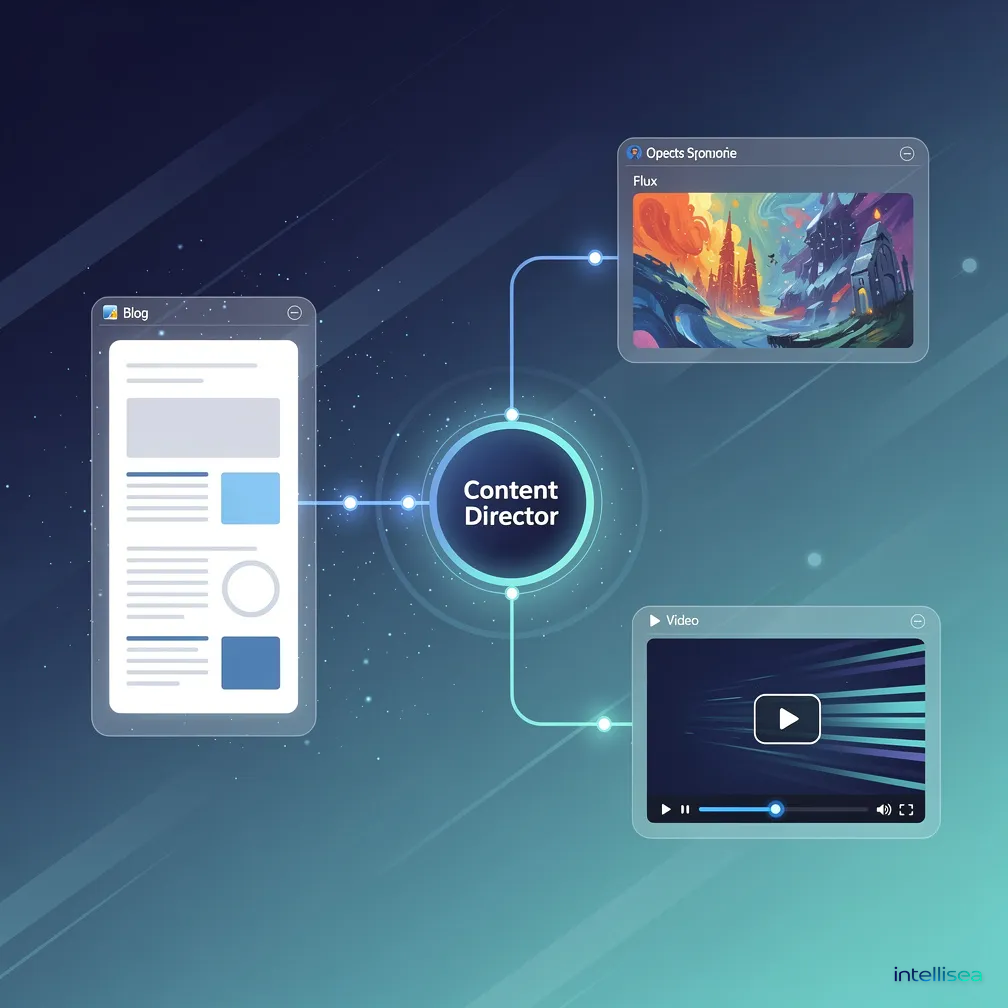
The content marketing landscape has fundamentally changed. Marketing managers and business owners no longer need to choose between quality and velocity when producing blog posts, images, and video. AI agents for content creation now handle the entire production workflow — from strategic planning through publication — while maintaining brand consistency and quality standards that previously required dedicated creative teams.
Unlike earlier generations of AI writing assistants that required constant human supervision, today's autonomous agents manage multi-step content workflows independently. They coordinate research, creation, optimization, and distribution across text, visual, and video formats. For organizations evaluating AI content marketing 2026 strategies, understanding how these agents function and where they excel represents a competitive necessity rather than an experimental luxury.
How AI Agents for Content Creation Work
AI agents differ fundamentally from simple AI tools. While a traditional AI writing assistant waits for your prompt and generates a single output, an agent operates with goal-oriented autonomy. You provide strategic parameters — target audience, content objectives, brand guidelines, SEO requirements — and the agent determines the optimal sequence of tasks to achieve those goals.
The architecture behind content creation agents typically involves several integrated components. A planning module breaks down your content objective into discrete tasks. An execution layer accesses multiple specialized AI models for writing, image generation, and video production. A quality control system evaluates outputs against your brand standards and content requirements. A learning mechanism improves performance based on which content achieves your defined success metrics.
Intellisea's Content Director agent exemplifies this architecture. Rather than simply generating text when prompted, it interprets a content brief, conducts competitive research, structures an optimized outline, produces draft content, generates supporting visuals, and prepares publication-ready assets — all within a unified workflow that maintains strategic alignment throughout each step.
The agent framework enables true automation because it handles decision-making that previously required human judgment. When should the tone shift from educational to persuasive? Which visual style best supports this particular message? What internal linking structure strengthens topical authority? Content agents make these determinations based on your configured parameters and content performance data.
Automated Blog Writing: From Keyword Brief to Published Post
The automated blog writing workflow demonstrates how agents transform content production economics. Here's the step-by-step process that replaces what traditionally required a content strategist, writer, editor, and SEO specialist:
Step 1: Strategic Input — You provide the target keyword, content objective, and audience specification. For Intellisea users, this happens through Content Canvas, the collaborative workspace where humans and agents coordinate content strategy.
Step 2: Competitive Intelligence — The agent analyzes top-ranking content for your target keyword, identifying content gaps, common structural patterns, and opportunities for differentiation. This research phase connects to the same analytical capabilities used in AI agents for SEO automation, ensuring content strategy aligns with search visibility objectives.
Step 3: Outline Generation — Based on research findings and your brand guidelines, the agent structures an optimized outline. This includes heading hierarchy, internal linking opportunities, and content depth recommendations for each section.
Step 4: Draft Production — The agent generates complete draft content, incorporating your brand voice configuration, style preferences, and tone specifications. Unlike template-based content, the output reflects strategic decisions about information hierarchy, persuasive elements, and reader experience.
Step 5: Quality Refinement — Automated quality checks verify brand voice consistency, readability metrics, SEO optimization, and factual accuracy flags. The agent iterates on sections that don't meet quality thresholds.
Step 6: Publication Preparation — The final output includes properly formatted HTML, meta descriptions, suggested internal links, and publication recommendations based on your content calendar. For a comprehensive look at how AI enhances every stage of SEO — including content optimization — see our practical guide to AI-driven SEO implementation.
This workflow reduces blog post production time from hours to minutes while maintaining quality standards that meet professional editorial requirements. The economic implications become significant at scale — a marketing team can maintain publication velocity that previously required substantially larger content operations.
AI-Generated Images: Branded Visuals Without a Design Team
Visual content creation represents another area where AI agents deliver immediate practical value. The integration of advanced image generation models like Flux enables content agents to produce branded visuals that align with written content without requiring design expertise or stock photo subscriptions.
The process begins with the agent analyzing your visual brand guidelines — color palettes, typography preferences, imagery style, and composition patterns. When generating blog post images, social media graphics, or marketing assets, the agent constructs detailed image generation prompts that incorporate these brand specifications.
Flux and similar models excel at producing photorealistic images, illustrations, and graphic designs from text descriptions. The agent determines which visual style best supports each content piece, generates multiple variations, and selects outputs that meet quality and brand consistency standards.
For marketing managers, this capability eliminates several traditional bottlenecks. You no longer need to brief designers, wait for revision cycles, or compromise visual quality when production timelines compress. The agent produces on-brand visuals as an integrated component of content creation rather than a separate workstream requiring coordination.
Brand voice configuration extends beyond text to visual elements. You define your visual identity once, and the agent applies those parameters consistently across all generated imagery. This ensures brand recognition remains strong even as content volume scales dramatically.
Short-Form Video: From Script to Publish in Minutes
Video content creation has historically represented the highest barrier to entry for content marketing teams. The technical requirements, production costs, and specialized expertise created a practical ceiling on video content volume for most organizations.
AI video generation models like Kling and Sora have fundamentally altered this equation. Content agents now orchestrate complete video production workflows — scriptwriting, scene generation, voiceover, editing, and export — without human involvement in technical execution.
The workflow begins with the agent developing a video script aligned with your content objectives. For product explainers, thought leadership content, or social media clips, the agent structures messaging for video format rather than simply repurposing blog content.
Video generation models then produce visual sequences matching the script. These tools create original video content rather than assembling stock footage, enabling highly specific visual storytelling that precisely matches your narrative requirements.
Voiceover generation adds professional narration in your selected voice profile and tone. The agent synchronizes audio with visual elements, applies transitions, and produces publication-ready video files optimized for your target distribution channels.
For marketing managers evaluating DIY digital marketing with agentic AI, video automation removes the need for expensive production vendors or in-house video specialists. You gain the ability to maintain consistent video content calendars with the same resource efficiency as blog publishing.
What AI Agents Can't Do Yet: Where Human Creativity Still Wins
Understanding current limitations helps organizations deploy AI agents effectively rather than expecting capabilities that don't yet exist. Several content creation domains still require human expertise and creative judgment.
Original strategic insight remains a human domain. While agents excel at analyzing existing content and identifying patterns, breakthrough positioning strategies and genuinely novel frameworks require human creative thinking.
Complex brand storytelling that weaves emotional narrative arcs across multiple content pieces benefits from human creative direction. Agents execute tactical content production excellently but don't yet conceptualize sophisticated narrative campaigns independently.
Nuanced stakeholder management and political sensitivity in content require human judgment. When content touches controversial topics, requires legal review, or involves complex stakeholder considerations, human oversight remains essential.
Genuine subject matter expertise in specialized domains exceeds current agent capabilities. While agents research topics effectively, they don't possess deep domain expertise that comes from years of professional experience in specialized fields.
The optimal deployment model combines agent automation for production execution with human expertise for strategic direction, creative vision, and specialized knowledge. This collaboration model delivers both the velocity benefits of automation and the quality advantages of human creativity.
Common Questions About AI Agents for Content Creation
How much does AI agent content creation cost compared to traditional methods? The economic model shifts from per-project costs to platform subscription fees. While traditional content creation involves variable costs for each piece produced, agent-based creation operates on fixed platform costs regardless of volume. Organizations typically see substantial cost reduction at scale.
Can AI agents maintain our specific brand voice? Modern content agents include sophisticated brand voice configuration that learns from your existing content. The more examples you provide during setup, the more accurately the agent replicates your distinctive voice, tone, and style preferences.
What happens when the agent produces incorrect information? Quality content agents include fact-checking protocols and flag uncertain claims for human review. However, human oversight remains important for specialized domains where accuracy is critical. The agent accelerates production but doesn't eliminate the need for editorial judgment.
How quickly can we implement AI agent content creation? Implementation timelines depend primarily on brand configuration complexity. Basic setup enabling immediate content production can happen within days. Sophisticated brand voice training and workflow customization may require several weeks of refinement.
Do AI-generated content pieces rank well in search engines? Search engines evaluate content quality and user value rather than production method. Well-configured content agents produce material that meets search quality standards because they optimize for the same relevance and user experience factors that determine rankings.
Transform Your Content Production Workflow
The transition from traditional content creation to agent-based production represents a fundamental shift in marketing operations. Organizations that deploy AI agents for content creation gain the ability to maintain publication velocity and content quality simultaneously — a combination that previously required choosing one priority over the other.
Intellisea's Content Director agent and Content Canvas workspace provide the integrated environment where marketing teams coordinate strategy while agents handle execution. From automated blog writing through branded image generation and video production, the complete content workflow operates with unprecedented efficiency.
The competitive implications extend beyond cost reduction. When your organization can test more content variations, respond faster to market developments, and maintain consistent publishing schedules without resource constraints, you gain strategic advantages that compound over time.
Ready to experience how AI agents transform content creation? Try the Intellisea content creation workflow and see how automated blog writing, image generation, and video production work together in a unified system designed for marketing teams who refuse to compromise between quality and velocity.