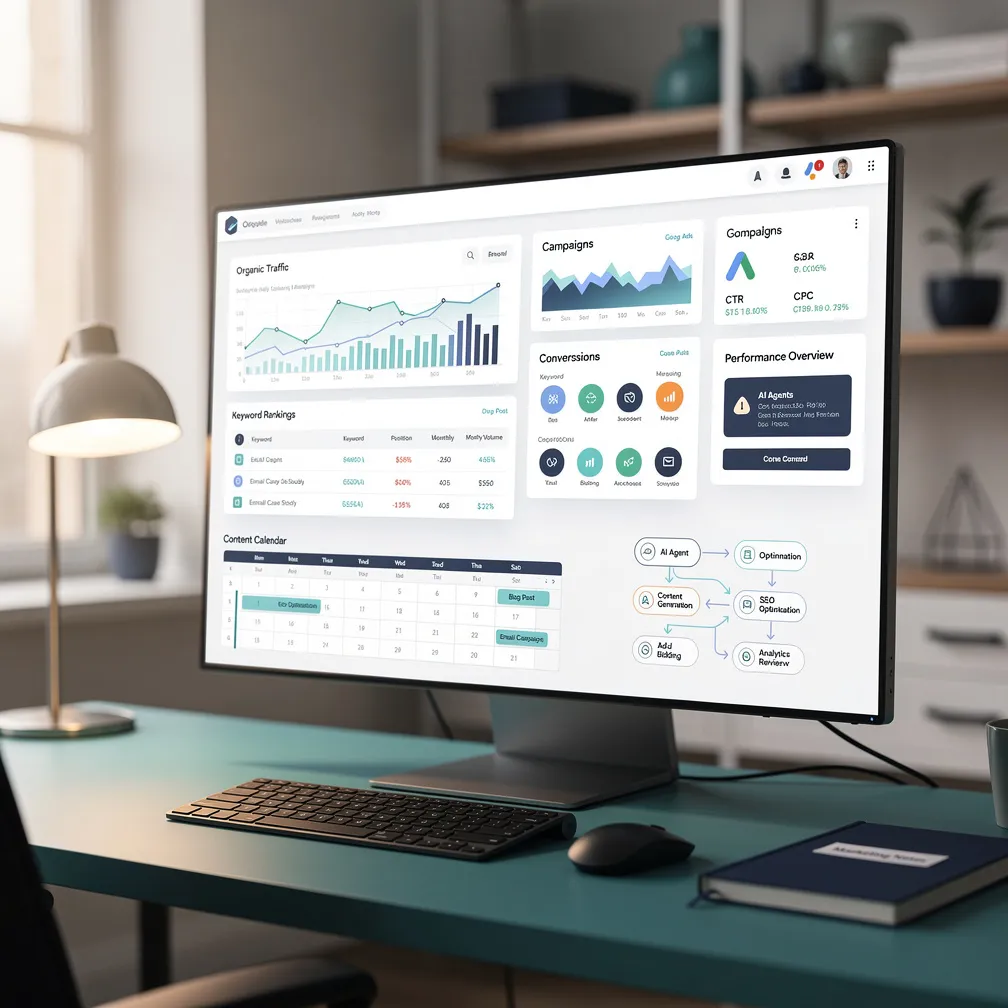
Agentic AI marketing is rewriting the playbook for digital agencies — but the real advantage isn't that AI agents execute campaigns. It's that they learn while they execute. Every keyword ranked, every ad dollar spent, and every content piece published feeds back into a learning workflow that makes the next decision sharper than the last.
If you've been evaluating an AI digital marketing agency, understanding how these learning workflows operate is the difference between choosing a platform that improves over time and one that simply automates the same mistakes at scale.
This article breaks down the learning workflows inside agentic AI marketing systems — specifically how Intellisea's autonomous marketing agents observe, adapt, and compound their performance across SEO, paid media, content, social, and analytics.
What Is a Learning Workflow in Agentic AI?
A learning workflow is the structured loop through which an AI agent collects performance data, evaluates it against objectives, updates its internal model, and adjusts its next action — without waiting for a human to intervene.
Traditional marketing tools generate reports. A human reads the report, interprets the data, decides on a change, and implements it days or weeks later. That's a feedback loop with a human bottleneck at every stage.
Agentic learning workflows compress that cycle into something closer to real time. The agent observes an outcome (a keyword moved from position 34 to position 22), evaluates whether the trajectory meets the objective (target: top 10 within 60 days), identifies what drove the movement (internal linking density, content freshness, backlink acquisition rate), and adjusts its next set of actions accordingly — all within the same operational cycle.
This is what separates an AI powered marketing agency from a traditional shop that bolted a chatbot onto its existing process. The learning workflow is the engine. Everything else is interface.
The Four Phases of an Agentic Learning Loop
Every learning workflow inside an agentic marketing system follows four phases:
- Observe — The agent collects structured data from live channels: search console impressions, ad auction results, social engagement signals, crawl responses, and conversion events.
- Evaluate — The agent compares observed outcomes against the objective it was given (e.g., rank keyword X in the top 20 within 30 days, or reduce cost per lead below a target threshold).
- Hypothesize — Based on the gap between the current state and the target, the agent generates candidate actions ranked by expected impact and confidence.
- Act — The agent executes the highest-confidence action, tags it for attribution, and re-enters the observe phase.
This loop runs continuously. There is no quarterly review. There is no "let's revisit this next month." The loop runs as fast as data arrives.
How Intellisea's Marketing Agents Learn Across Five Channels
Intellisea's agentic AI platform deploys specialized agents across SEO, content, paid media, social, and analytics. Each agent runs its own learning workflow, but they share a common data layer — meaning a discovery in one channel immediately informs the others.
SEO Agent: Learning to Rank
The SEO agent's learning workflow centers on ranking trajectory analysis. Rather than treating each keyword as an isolated target, the agent builds a model of how the site's topical authority develops over time.
What the loop looks like in practice:
- Observe: The agent monitors daily ranking positions, crawl frequency, index coverage, and click-through rates from search console data.
- Evaluate: For each target keyword, the agent calculates a ranking velocity — is the keyword accelerating toward the target position, decelerating, or stalled?
- Hypothesize: If a keyword's velocity is declining, the agent evaluates contributing factors: Has a competitor published new content on the same topic? Has the page's internal link equity dropped because a linking page was deindexed? Is the content's freshness signal fading?
- Act: The agent executes a corrective action — refreshing the content's publish date with new data, adding internal links from recently published articles, or flagging a technical issue for the technical audit workflow.
Over dozens of cycles, the SEO agent develops a nuanced model of what moves rankings for this specific domain — not generic SEO best practices, but the particular combination of content depth, link density, and freshness cadence that Google rewards for Intellisea's topical cluster.
Content Agent: Learning What Resonates
The content agent's learning workflow goes beyond "what keywords should we target" into how content should be structured to earn engagement and rankings simultaneously.
Key learning signals:
- Dwell time and scroll depth by content section — the agent learns which H2 structures hold readers and which lose them.
- Featured snippet capture rate — the agent tests different answer formats (paragraph, list, table) for FAQ sections and learns which format Google selects for each query type.
- Internal link click-through — the agent monitors which contextual links readers actually follow, revealing content affinity patterns that inform future topic sequencing.
After several articles are published, the content agent builds a site-specific content model. It knows that definition-style H2s in the 150–200 word range perform best for informational queries on this domain. It knows that FAQ sections with five questions outperform those with three. It knows that comparison tables earn more featured snippets than bulleted lists for this site's authority level.
None of that is programmed in advance. It's learned.
Paid Media Agent: Learning to Spend
The paid media agent manages Google Ads and Meta campaigns with a learning workflow optimized for cost efficiency at every decision point.
The bid-level learning loop:
- Observe: The agent tracks impression share, click-through rate, cost per click, conversion rate, and cost per acquisition at the keyword, ad group, and campaign level.
- Evaluate: Performance is compared against the target CPA or ROAS set at the campaign level. The agent also evaluates budget utilization — is the daily budget being exhausted too early, leaving high-converting afternoon hours unfunded?
- Hypothesize: The agent generates micro-adjustments: bid modifier changes by device, time of day, and audience segment. It also identifies keyword-level decisions — pause underperformers, increase bids on high-converting terms, add negative keywords from search term analysis.
- Act: Adjustments are executed and tagged. The next observation cycle measures whether the change moved the target metric in the right direction.
The critical advantage over human management: this loop runs at auction frequency. A human PPC manager reviews performance weekly or monthly. The paid media agent evaluates and adjusts with every new data point.
Social Media Agent: Learning Engagement Patterns
The social agent's learning workflow focuses on timing, format, and topic resonance across LinkedIn, Meta, and Instagram.
What the agent learns over time:
- Optimal posting windows — not generic "best times to post" data from industry studies, but the specific days and hours when this account's audience is most active and responsive.
- Format performance — the agent compares engagement rates across text posts, image posts, carousels, and video by platform. It learns that LinkedIn carousel posts outperform text-only posts by a measurable margin for this audience, while Instagram stories drive more profile visits than feed posts.
- Topic mapping — the agent correlates content topics with engagement signals (saves, shares, comments vs. passive likes) and weights future content recommendations toward topics that drive meaningful interaction rather than vanity metrics.
Analytics Agent: The Learning Orchestrator
The analytics agent operates as the cross-channel learning layer. Its workflow isn't about executing marketing actions — it's about identifying patterns that no single-channel agent can see on its own.
Cross-channel learning examples:
- A spike in branded search volume following a LinkedIn post reveals that social content is driving search demand — the SEO agent adjusts its branded keyword strategy accordingly.
- A decline in organic CTR on a page that recently lost its featured snippet triggers the content agent to reformat the answer structure.
- An increase in direct traffic correlated with a Google Ads brand campaign raises the question of attribution blending — the analytics agent flags this for the paid media agent's budget allocation model.
This orchestration layer is what makes the system agentic rather than just automated. The agents don't operate in silos. They share a learning substrate.
Why Learning Workflows Compound Over Time
The most important property of agentic learning workflows is that they compound. Each cycle doesn't just solve the immediate problem — it refines the model that solves all future problems in the same category.
Consider the difference:
| Metric | Month 1 | Month 6 | Why |
|---|---|---|---|
| Average time to rank a new keyword in top 50 | 21 days | 12 days | The SEO agent has learned optimal content structure, internal linking patterns, and freshness cadence for this domain |
| Cost per acquisition (Google Ads) | Baseline | 20–35% lower | The paid media agent has pruned low-converting segments and concentrated budget on proven performers |
| Content engagement rate | Baseline | Higher scroll depth and lower bounce rate | The content agent has learned which formats and structures retain this audience |
| Campaign launch time | Days of setup | Hours | Workflow patterns from previous campaigns are reused and refined |
This compounding effect is why the value of an AI powered marketing agency increases over time rather than staying flat. A traditional agency's output is bounded by headcount and hours. An agentic system's output is bounded by data — and data only grows.
Red Flags: When "AI Learning" Is Just Reporting
Not every agency that claims AI learning workflows actually has them. Here's how to tell the difference:
They show you dashboards, not decisions. A dashboard that visualizes last month's data is a reporting tool, not a learning workflow. Ask what the system did with the data — not what it showed you.
Optimizations happen on a human schedule. If campaign adjustments happen weekly or monthly, a human is still in the loop at the decision stage. Genuine agentic learning operates on data-arrival frequency, not calendar frequency.
The same playbook runs for every client. Learning workflows are domain-specific by definition. If the agency runs an identical content strategy for a SaaS company and a dental practice, the learning loop isn't influencing the strategy.
No attribution tagging on agent actions. If you can't trace a specific ranking improvement or cost reduction back to a specific agent decision, the system lacks the observe → evaluate → act accountability that makes learning workflows trustable.
Frequently Asked Questions
How do agentic AI learning workflows differ from marketing automation?
Marketing automation executes predefined rules: "If email open rate drops below 15%, send a re-engagement sequence." Agentic learning workflows generate their own hypotheses and test them. The agent doesn't follow a script — it observes outcomes, identifies patterns, and acts on what it learns. Automation is deterministic. Agentic learning is adaptive.
Can AI marketing agents learn from mistakes?
Yes — and that's the core mechanism. When an agent executes an action that doesn't improve the target metric, that outcome is tagged as negative signal in the evaluation phase. The agent's confidence model adjusts, making it less likely to repeat the same action in similar conditions. Over hundreds of cycles, this pruning effect is substantial.
How long before agentic learning workflows show measurable results?
Most learning effects become visible within 30–60 days. SEO learning workflows need crawl and ranking cycles to validate hypotheses, so expect 3–6 weeks for ranking improvements. Paid media learning workflows show faster results — bid optimization effects can appear within the first 7–14 days as the agent gathers auction-level data.
What data do the agents need to learn effectively?
The agents need access to the live channel data: Google Search Console, Google Ads, Meta Ads Manager, social platform analytics, and website analytics. The richer and more granular the data access, the faster and more accurate the learning loops become. Intellisea's platform connects directly to these data sources so agents operate on real-time signals, not exported CSVs.
The Bottom Line: Learning Is the Moat
Any agency can run a Google Ads campaign. Any agency can publish a blog post. The differentiator isn't execution — it's the rate at which execution improves.
Agentic AI learning workflows give Intellisea's marketing agents a compounding advantage that widens over time. Every campaign, every keyword, every ad dollar spent makes the system sharper for the next decision. That's not a feature. It's a fundamentally different operating model.
If you want to see how learning workflows would apply to your specific marketing channels, request a free AI marketing audit. We'll show you exactly where autonomous agents can start learning — and compounding — for your business.