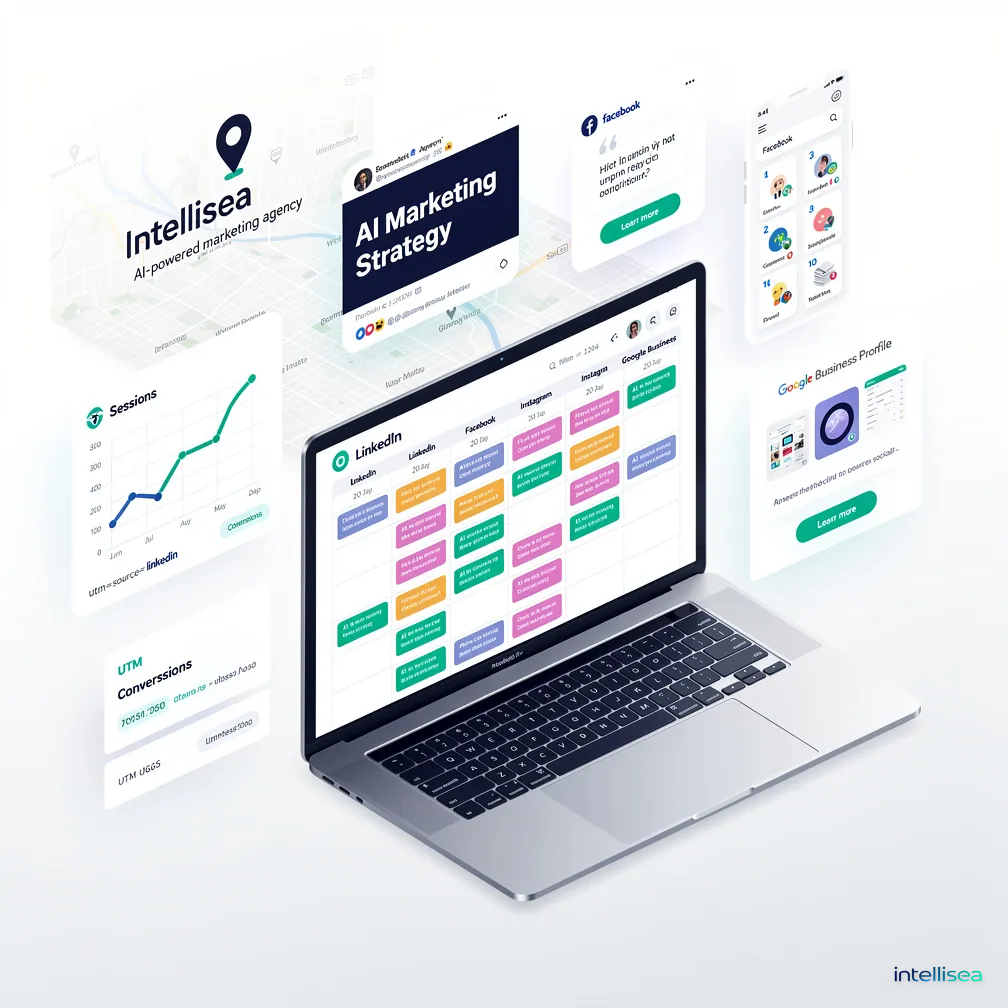
Choosing between an AI driven marketing agency and a traditional shop isn't just a technology decision — it's a growth-model decision. Here's what actually changes when autonomous AI agents run your campaigns.
The marketing agency landscape has split in two. On one side, traditional agencies operate the way they have for decades — account managers relay requests, specialists execute in silos, and reporting arrives weeks after the data mattered. On the other, a new breed of AI driven marketing agency deploys autonomous agents that monitor, optimize, and execute around the clock.
If you're evaluating partners for 2026 and beyond, you need more than a vendor's word that they "use AI." You need a clear, honest comparison of what each model delivers — and where each falls short.
This guide puts both models side by side so you can make that call with data, not buzzwords.
What Defines an AI-Driven Agency vs. a Traditional Agency
A traditional digital marketing agency relies on human specialists organized by discipline — SEO, paid media, content, analytics. Strategy is developed in kickoff meetings, executed through project management tools, and reviewed in monthly reports. Every optimization requires a human to notice the opportunity, propose a change, get approval, and implement it.
An AI driven marketing agency still employs strategists and specialists, but the execution layer is fundamentally different. Autonomous AI agents handle the high-frequency, data-intensive work: bid adjustments in real time, content generation at scale, keyword monitoring across thousands of queries, and cross-channel budget reallocation without waiting for a Monday morning standup.
The critical distinction isn't "uses AI tools" — most agencies do that now. It's whether the agency operates an agentic AI platform where AI agents independently execute tasks, learn from outcomes, and coordinate with each other. Think of it as the difference between a pilot who checks a weather app before takeoff and an autopilot system that continuously adjusts altitude, speed, and heading based on real-time atmospheric data.
An AI-powered digital marketing agency that runs on agentic architecture doesn't just respond faster. It operates on a fundamentally different clock — one that never stops.
Side-by-Side Comparison: AI Driven vs. Traditional Agency
Here's how the two models compare across the six dimensions that matter most to marketing performance:
| Dimension | Traditional Agency | AI Driven Marketing Agency |
|---|---|---|
| Speed of Execution | Days to weeks. Changes go through account managers, internal review, and implementation queues. Campaign pivots require meeting cycles. | Minutes to hours. Autonomous agents detect shifts in performance data and execute adjustments immediately — bid changes, budget reallocation, content updates — without waiting for human approval on routine optimizations. |
| Data Usage | Periodic. Analysts pull reports weekly or monthly, review dashboards, and surface insights manually. Decisions are based on snapshots, not streams. | Continuous. AI agents ingest data in real time across every channel — search console, ad platforms, analytics, CRM — and act on patterns the moment they emerge. No lag between signal and response. |
| Personalization | Segment-level. Traditional teams build 3–5 audience segments and create tailored messaging for each. Deeper personalization is possible but labor-prohibitive. | Individual-level at scale. AI agents generate and test hundreds of creative variations, landing page combinations, and audience micro-segments simultaneously. Personalization becomes a function of compute, not headcount. |
| Cost Efficiency | Linear scaling. Doubling the workload means doubling the team — more specialists, more project managers, higher retainers. Margins compress as scope grows. | Non-linear scaling. An AI-powered marketing agency can expand campaign scope, add channels, or increase testing velocity without proportionally increasing costs. The marginal cost of the next optimization approaches zero. |
| Scalability | Constrained by talent. Hiring, training, and retaining specialists is the bottleneck. Seasonal surges require freelancers or overtime. | Elastic. AI agents scale horizontally — the same platform handles 10 campaigns or 10,000. Seasonal demand doesn't create staffing crises. |
| Reporting & Transparency | Scheduled. Monthly PDF decks arrive 1–2 weeks after the reporting period. Real-time dashboards exist but require human narration to be actionable. | Always-on. Dashboards update continuously, and AI agents generate plain-language summaries of what changed, why, and what they did about it. Anomaly detection flags issues before they become problems. |
Neither model is universally "better." A traditional agency may be the right fit for a business that needs deep brand strategy work, creative campaigns that require human intuition, or industries where regulatory review makes autonomous execution impractical. But for performance marketing — SEO, paid search, paid social, content at scale — an AI driven marketing agency has structural advantages that compound over time.
How Intellisea's Agentic AI Platform Bridges the Gap
Most agencies that call themselves "AI-powered" are bolting AI tools onto a traditional workflow. They use ChatGPT for draft copy, an AI analytics dashboard for reporting, maybe an automated bidding tool inside Google Ads. The humans still orchestrate everything.
Intellisea operates differently. Our agentic AI platform deploys autonomous campaign agents — purpose-built AI systems that don't just assist human marketers but independently execute defined marketing functions 24/7.
Here's what that looks like in practice:
SEO Agent. Continuously monitors keyword rankings, crawl health, and competitor movements. When it detects a ranking drop, it diagnoses the cause — content decay, technical issue, competitor gain — and either fixes it directly (re-optimizing meta tags, updating internal links, refreshing thin content) or escalates to a strategist with a specific recommendation and supporting data.
Ads Agent. Manages bid strategies, budget allocation, and ad creative testing across Google Ads and Meta in real time. It doesn't wait for a weekly optimization call. When a keyword's conversion rate shifts, the agent adjusts bids within minutes. When a creative fatigues, it generates new variations and launches A/B tests automatically.
Content Agent. Identifies content gaps from keyword and SERP analysis, generates drafts aligned to editorial guidelines and brand voice, and queues them for human review. Instead of a content calendar that plans 4 posts per month, the agent can produce and optimize dozens of pieces based on what the data says is needed right now.
Analytics Agent. Correlates data across Google Analytics, Search Console, ad platforms, and CRM systems to surface cross-channel insights no single-channel analyst would catch. It generates automated briefings — not raw dashboards, but narrative explanations of what's working, what's not, and what the other agents are doing about it.
These agents don't work in isolation. They coordinate. When the SEO agent identifies a high-opportunity keyword cluster, it passes that intelligence to the Content agent to prioritize production and to the Ads agent to test paid traffic on those terms. That kind of cross-functional, real-time orchestration is nearly impossible to replicate with human teams alone — not because the humans aren't skilled, but because the communication and coordination overhead makes it too slow.
This is the gap that agentic AI bridges: the space between knowing what to do and doing it fast enough for it to matter. If you're exploring what a full-service AI agency actually delivers, our breakdown of AI marketing agency services covers the specific capabilities to evaluate.
When to Choose an AI Agency vs. Staying Traditional
The right choice depends on where your business is and what you need marketing to do.
Choose a traditional agency when:
- You need brand-building from scratch. Developing a brand identity, visual language, and market positioning requires human creativity and strategic judgment that AI agents don't replicate.
- Your industry has strict regulatory review processes. If every ad, email, and landing page needs legal sign-off before going live, autonomous execution creates compliance risk rather than speed.
- You value a single point of contact above all else. Traditional agencies excel at the relationship layer — a dedicated account manager who knows your business and serves as a strategic partner.
- Your marketing scope is narrow and stable. If you run 2–3 campaigns with minimal testing needs, the overhead of an agentic platform may not deliver enough incremental value.
Choose an AI driven marketing agency when:
- Performance marketing is your priority. SEO, paid search, paid social, and conversion rate optimization are data-dense, high-frequency disciplines where AI agents create the greatest leverage.
- You need to scale without linearly scaling costs. If growth means more channels, more markets, more content, or more testing — and your budget can't support a proportionally larger team — AI-powered execution is the path.
- Speed of optimization matters. In competitive markets, the agency that adjusts bids, refreshes content, and reallocates budget fastest captures disproportionate value. A 48-hour delay on a bid adjustment is a 48-hour gift to your competitors.
- You want continuous operation, not business-hours-only marketing. AI agents don't take weekends. For e-commerce brands, SaaS companies, and businesses with global audiences, 24/7 optimization isn't a luxury — it's a competitive requirement.
- You're data-rich but insight-poor. If you have data from analytics, CRM, ad platforms, and social channels but struggle to turn it into action, an AI-powered digital marketing agency can close that gap automatically.
Many businesses find the right answer isn't either/or. The most effective model pairs human strategic oversight with AI-driven execution — humans set the goals, define the guardrails, and make judgment calls, while agents handle the volume, velocity, and variance of modern digital marketing.
That's the model Intellisea was built on. Our strategists define the direction. Our agentic AI platform executes it — continuously, autonomously, and at a scale no human-only team can match.
Frequently Asked Questions
Are AI marketing agencies better than traditional ones?
Not universally — but for performance marketing disciplines like SEO, paid media, and content at scale, an AI driven marketing agency has structural advantages in speed, data processing, and cost efficiency. Traditional agencies remain strong for brand strategy, creative campaigns, and relationship-driven account management.
What is an AI-driven marketing agency?
An AI-driven marketing agency uses artificial intelligence not just as a tool but as a core execution layer. The most advanced version — an agentic AI agency — deploys autonomous agents that independently monitor data, optimize campaigns, and execute marketing tasks 24/7 with human strategic oversight.
Will AI replace marketing agencies?
AI won't replace agencies — it will reshape them. Agencies that integrate agentic AI into their operations can deliver faster results at lower marginal cost. Those that don't will struggle to compete on speed and scalability. The future belongs to agencies that pair human judgment with AI execution.
How do AI agencies reduce costs?
AI agencies reduce costs through non-linear scaling. An autonomous agent that manages bid optimization, content production, or keyword monitoring doesn't require proportionally more resources as scope increases. The same platform that runs 10 campaigns can run 100 — without hiring 10x more specialists. This compresses the cost per optimization and increases ROI for every dollar of retainer spend.
Ready to See the Difference?
The gap between AI driven and traditional marketing isn't theoretical — it shows up in response time, optimization frequency, and compounding performance gains.
Book a strategy session with Intellisea to see how our agentic AI platform operates on your actual data, your real campaigns, and your specific growth targets. No pitch deck. Just a live walkthrough of what autonomous AI agents would do for your business in the first 30 days.