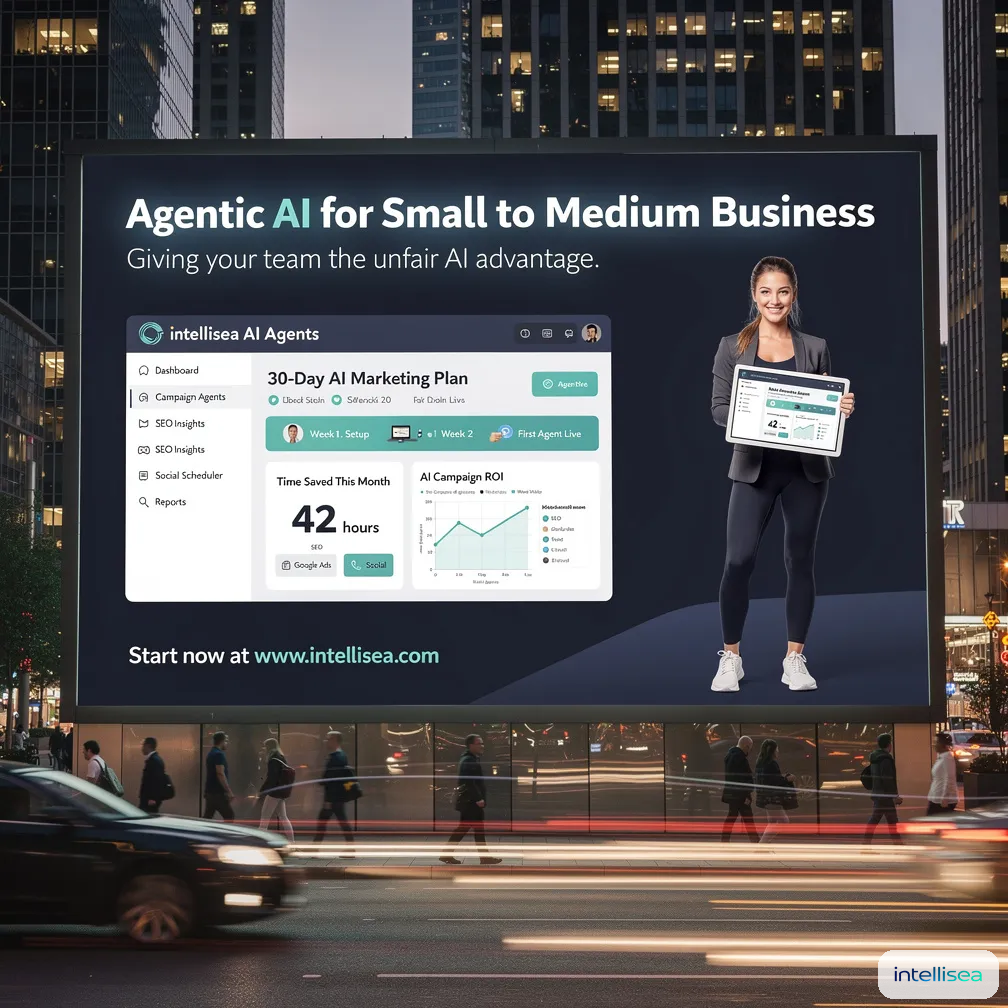
The marketing landscape has fundamentally shifted. While traditional automation handles repetitive tasks based on rigid rules, AI Marketing Agents operate with genuine autonomy—observing, deciding, and executing across channels without constant human intervention. These autonomous systems are transforming how marketing teams operate in 2026, moving from reactive task completion to proactive strategy execution.
This comprehensive playbook will guide you through deploying Marketing Automation across your entire marketing operation. You'll learn what differentiates Agentic AI Marketing from traditional automation, discover the five core agent types that form a complete marketing intelligence system, and gain step-by-step implementation frameworks that marketing leaders are using to achieve measurable results.
Whether you're a CMO evaluating Autonomous Marketing solutions or a digital marketing professional tasked with AI implementation, this guide provides the strategic and tactical knowledge you need to deploy AI agents that deliver compound returns across every channel.
What Are AI Agents in Digital Marketing
Marketing Automation represent a fundamental evolution beyond traditional marketing automation. While conventional automation systems execute predefined workflows based on if-then logic, AI Marketing Agents possess three distinguishing characteristics that enable true autonomy.
First, Marketing Automation maintain persistent awareness of their environment. They continuously monitor performance metrics, competitor activities, audience behaviors, and market conditions across all relevant channels. This ongoing observation creates a dynamic understanding of the marketing landscape rather than relying on static rules.
Second, these agents make independent decisions based on objectives rather than scripts. Instead of following predetermined paths, they evaluate multiple options, predict outcomes, and select actions that advance defined goals. An AI agent managing paid search doesn't simply pause underperforming ads—it analyzes why performance declined, tests alternative approaches, and reallocates budget to maximize return on ad spend.
Third, Agentic AI Marketing systems learn and adapt from outcomes. Each action generates data that refines the agent's decision-making models. Over time, these systems develop sophisticated understanding of what works in your specific market context, continuously improving performance without manual retraining.
The distinction between traditional automation and Marketing Automation becomes clear in practical application. Traditional automation might send an email when a prospect downloads a whitepaper. An AI agent analyzes that prospect's complete behavioral profile, evaluates their position in the buyer journey, determines optimal messaging based on similar successful conversions, selects the highest-performing content format, chooses the ideal send time based on engagement patterns, and adjusts the entire nurture sequence based on response.
This autonomous operation doesn't eliminate human oversight—it elevates it. Marketing teams shift from executing tasks to defining strategy, setting objectives, and guiding agent behavior at a higher level. The result is marketing that operates with both scale and sophistication previously impossible to achieve.
The 5 Core AI Agent Types Every Marketing Team Needs
Deploying Autonomous Marketing effectively requires understanding the specialized agent types that comprise a complete system. Each agent focuses on a specific domain while coordinating with others to create integrated marketing intelligence.
SEO Director Agent
The SEO Director agent functions as an autonomous search optimization strategist. This agent continuously analyzes search rankings, monitors algorithm updates, identifies content gaps, and executes optimization strategies across your digital properties.
Key capabilities include keyword opportunity identification based on search volume trends and competitive gaps, content optimization recommendations that balance search intent with conversion objectives, technical SEO monitoring that identifies and prioritizes issues affecting visibility, backlink analysis that uncovers link-building opportunities, and competitive intelligence that reveals strategic shifts in your market.
The SEO Director agent operates with a long-term perspective, understanding that search optimization requires sustained effort across multiple fronts. It prioritizes actions based on potential impact and resource requirements, ensuring your team focuses on initiatives that move the needle.
Google Ads Director Agent
The Google Ads Director agent manages paid search campaigns with the sophistication of an experienced performance marketer. This agent continuously optimizes bidding strategies, ad creative, audience targeting, and budget allocation to maximize return on ad spend.
Core functions include real-time bid optimization that responds to conversion probability signals, ad copy testing that identifies high-performing messaging variations, audience segmentation that reveals profitable customer micro-segments, budget reallocation across campaigns based on performance trends, and negative keyword identification that eliminates wasted spend.
Unlike rule-based automation, the Google Ads Director agent understands context. It recognizes when performance changes reflect genuine trends versus temporary fluctuations, adjusts strategies based on business cycle patterns, and coordinates with other agents to align paid search with broader marketing initiatives.
Content Director Agent
The Content Director agent orchestrates content strategy and production across all formats and channels. This agent identifies content opportunities, generates briefs, optimizes existing assets, and ensures content aligns with both audience needs and business objectives.
Primary responsibilities include content gap analysis that reveals unmet audience information needs, editorial calendar optimization that balances strategic priorities with production capacity, content performance analysis that identifies patterns in successful assets, repurposing recommendations that maximize content investment, and SEO integration that ensures content achieves visibility.
The Content Director agent excels at connecting content to outcomes. It tracks how specific assets contribute to pipeline generation, identifies which content types drive progression through buyer journeys, and recommends strategic shifts based on performance data.
Social Director Agent
The Social Director agent manages social media presence with strategic sophistication. Beyond scheduling posts, this agent analyzes audience engagement patterns, identifies trending topics relevant to your brand, optimizes posting strategies, and coordinates social efforts with broader marketing campaigns.
Key capabilities include engagement optimization that determines ideal posting times and content formats for each platform, conversation monitoring that identifies brand mentions and engagement opportunities, influencer identification that reveals potential partnership opportunities, content curation that surfaces relevant third-party content, and sentiment analysis that tracks brand perception.
The Social Director agent understands that social media success requires responsiveness and cultural awareness. It adapts strategies based on platform algorithm changes, identifies emerging trends before they peak, and ensures your brand maintains relevant presence without appearing opportunistic.
Analytics Director Agent
The Analytics Director agent serves as the intelligence hub that connects all other agents. This agent synthesizes data across channels, identifies cross-channel patterns, attributes results to specific initiatives, and provides actionable insights that guide strategic decisions.
Core functions include multi-touch attribution that reveals true campaign contribution, anomaly detection that flags unusual patterns requiring attention, predictive analytics that forecast performance trends, cross-channel analysis that identifies synergies and conflicts, and reporting automation that delivers relevant insights to stakeholders.
The Analytics Director agent transforms data from a historical record into a strategic asset. It doesn't simply report what happened—it explains why, predicts what's likely to occur, and recommends actions to optimize outcomes.
How to Set Up Your First AI Marketing Agent Step by Step
Deploying your first AI marketing agent requires systematic planning and execution. This step-by-step framework ensures successful implementation that delivers measurable results.
Step One: Select Your Initial Agent Based on Maximum Impact
Begin by identifying which agent type will deliver the greatest immediate value for your organization. Consider three factors: current pain points, available data, and team readiness.
If paid search represents a significant budget line with inconsistent performance, the Google Ads Director agent likely offers the highest immediate ROI. If content production consumes substantial resources without clear performance visibility, the Content Director agent may provide greater value. Choose the agent that addresses your most pressing challenge while leveraging existing data assets.
Step Two: Define Clear Objectives and Success Metrics
Marketing Automation require explicit goals to operate effectively. Define what success looks like in specific, measurable terms. Rather than vague objectives like improve campaign performance, specify targets such as increase conversion rate by fifteen percent while maintaining cost per acquisition below fifty dollars.
Establish both primary objectives that define overall success and secondary metrics that provide leading indicators. Include constraints that prevent undesirable outcomes—for example, maintain brand safety standards or respect budget caps.
Step Three: Audit and Prepare Your Data Infrastructure
Autonomous marketing depends on data quality and accessibility. Audit your current data infrastructure to identify gaps and inconsistencies. Ensure your agent will have access to complete, accurate data across relevant systems.
Key data requirements include historical performance data spanning sufficient time to identify patterns, conversion tracking that connects marketing activities to business outcomes, audience data that enables segmentation and personalization, competitive intelligence that provides market context, and technical integration with platforms where the agent will operate.
Address data quality issues before deployment. AI agents amplify existing data problems—incomplete tracking or inconsistent tagging will limit agent effectiveness.
Step Four: Configure Agent Parameters and Guardrails
Define the operational boundaries within which your agent will function. Specify budget limits, brand guidelines, approval requirements, and risk tolerances. These guardrails ensure autonomous operation remains aligned with organizational standards.
Configure escalation protocols that determine when the agent should seek human input. Early deployments benefit from tighter guardrails that expand as the agent demonstrates reliable performance and your team develops confidence.
Step Five: Deploy in Controlled Testing Environment
Launch your first AI marketing agent in a controlled environment that limits risk while providing meaningful performance data. Allocate a portion of budget or focus on a specific campaign segment for initial deployment.
This testing phase serves multiple purposes: validating technical integration, confirming the agent interprets objectives correctly, identifying unexpected behaviors, and generating performance data that informs full-scale deployment.
Monitor closely during this phase, reviewing agent decisions and outcomes daily. Look for patterns in decision-making, assess whether actions align with strategic intent, and adjust parameters as needed.
Step Six: Scale Based on Validated Performance
Once your agent demonstrates consistent performance in the testing environment, expand its operational scope. Increase budget allocation, extend to additional campaigns, or broaden the range of autonomous actions.
Scale incrementally, expanding control gradually while maintaining oversight. This measured approach builds organizational confidence while minimizing risk.
Step Seven: Establish Ongoing Optimization Cadence
Marketing Automation improve through continuous learning, but they benefit from periodic strategic review. Establish a regular cadence for evaluating agent performance, refining objectives, and updating parameters based on business priorities.
Monthly reviews typically provide sufficient frequency to identify optimization opportunities without creating excessive overhead. Focus these reviews on strategic alignment rather than tactical decisions—the agent handles tactics autonomously.
Real-World AI Agent Workflows in Action
Understanding how Marketing Automation operate in practice clarifies their value proposition. These real-world workflows demonstrate Autonomous Marketing across different scenarios.
Workflow One: Autonomous Content Gap Identification and Production
The Content Director agent continuously analyzes search queries driving traffic to competitor sites, identifying topics where your content library lacks coverage. When it identifies a significant gap—high search volume topics relevant to your audience but absent from your content—it generates a detailed content brief.
This brief includes keyword targets, search intent analysis, competitive content analysis showing what existing content covers, recommended content structure, and strategic rationale explaining why this content supports business objectives.
The agent then coordinates with the SEO Director agent to ensure the brief incorporates technical optimization requirements. Once the content is produced, the Content Director agent monitors performance, identifies optimization opportunities, and recommends distribution strategies to maximize reach.
This workflow transforms content strategy from reactive production to proactive opportunity capture, ensuring your content library continuously expands to meet audience needs.
Workflow Two: Cross-Channel Campaign Optimization
When launching a new product campaign, multiple AI agents coordinate to optimize performance across channels. The Google Ads Director agent manages paid search, testing ad variations and adjusting bids based on conversion signals. The Social Director agent identifies optimal posting strategies and engagement opportunities across platforms.
The Analytics Director agent monitors performance across all channels, identifying which combinations drive the highest conversion rates. It discovers, for example, that prospects who engage with social content before clicking paid search ads convert at significantly higher rates.
Based on this insight, the agents adjust strategy. The Social Director increases content distribution targeting audiences likely to search for relevant terms. The Google Ads Director adjusts bidding for users who previously engaged with social content, recognizing their higher conversion probability.
This cross-channel coordination creates compound returns impossible to achieve with siloed optimization, as agents continuously identify and exploit synergies.
Workflow Three: Automated Competitive Response
The SEO Director agent monitors competitor rankings daily, tracking position changes across priority keywords. When a competitor launches a comprehensive content piece that captures rankings for strategically important terms, the agent immediately identifies the threat.
It analyzes the competitor content, identifying strengths and gaps. The agent then generates a strategic response plan, recommending either content updates to existing assets or new content creation to recapture visibility. It prioritizes based on traffic potential and business value.
Simultaneously, the Google Ads Director agent adjusts paid search strategy to maintain visibility for affected terms while organic rankings recover. This coordinated response happens autonomously, ensuring competitive threats receive immediate attention rather than languishing until the next strategy meeting.
Workflow Four: Predictive Budget Reallocation
The Analytics Director agent continuously analyzes performance trends across all marketing channels, building predictive models of future performance based on historical patterns and current signals.
When it identifies that paid search typically experiences increased conversion rates during specific business cycles while social media engagement declines, it recommends proactive budget reallocation. The Google Ads Director agent receives increased budget allocation during high-performance periods, while the Social Director agent shifts focus to audience building rather than immediate conversion during lower-performing periods.
This predictive approach optimizes resource allocation based on expected returns rather than reactive adjustments after performance changes, maximizing overall marketing efficiency.
How to Measure AI Marketing Agent ROI
Measuring the return on investment from Marketing Automation requires a comprehensive framework that captures both direct performance improvements and operational efficiencies.
Direct Performance Metrics
Begin with channel-specific performance indicators that demonstrate agent impact on core marketing outcomes. For paid search agents, track cost per acquisition changes, conversion rate improvements, return on ad spend trends, and impression share gains. For content agents, monitor organic traffic growth, search ranking improvements, engagement rate changes, and content-driven conversion increases.
Compare performance during agent operation against baseline periods using controlled analysis. Isolate agent impact from external factors by examining performance across similar time periods, market conditions, and budget levels.
Operational Efficiency Gains
Marketing Automation deliver substantial value through operational efficiency that frees human resources for strategic work. Quantify time savings across routine tasks that agents now handle autonomously.
Calculate hours previously spent on campaign monitoring, bid adjustments, performance reporting, content optimization, and competitive analysis. Multiply these hours by loaded labor costs to determine operational savings.
Beyond direct time savings, consider opportunity costs. When senior marketers spend less time on tactical execution, they invest more in strategy development, creative innovation, and customer insight—activities that drive disproportionate value but often receive insufficient attention.
Speed and Responsiveness Improvements
Autonomous marketing operates continuously, responding to opportunities and threats far faster than human-dependent processes. Measure the value of this responsiveness through reduced reaction time to performance changes, faster identification of optimization opportunities, and accelerated testing velocity.
Calculate the revenue impact of faster optimization cycles. If an AI agent identifies and resolves a conversion funnel issue in hours rather than weeks, quantify the revenue that would have been lost during the delayed response period.
Cross-Channel Synergy Value
Multi-agent coordination creates value that exceeds the sum of individual agent contributions. The Analytics Director agent identifying cross-channel synergies enables optimization impossible with siloed management.
Measure this synergy value by comparing multi-channel campaign performance before and after agent deployment. Look specifically for improvements in assisted conversions, cross-channel attribution clarity, and coordinated campaign effectiveness.
Compound Learning Effects
Marketing Automation improve continuously through learning from outcomes. This creates compound value that accelerates over time. Track performance trends across extended periods to capture this learning effect.
Calculate the rate of improvement in key metrics, demonstrating how agent performance enhances month over month. Project this improvement trajectory to estimate future value creation.
Comprehensive ROI Calculation Framework
Synthesize these components into a comprehensive ROI calculation. Total value created equals direct performance improvements plus operational efficiency gains plus responsiveness value plus cross-channel synergy value plus projected compound learning effects.
Compare this total value against implementation costs including platform fees, integration expenses, training investments, and ongoing management overhead. Calculate ROI as total value created divided by total costs.
For most marketing organizations deploying AI agents effectively, ROI exceeds three hundred percent within the first year, with increasing returns in subsequent years as learning effects compound and operational integration deepens.
Multi-Channel Coordination Where AI Agents Create Compound Returns
The greatest value from Marketing Automation emerges not from individual agent performance but from coordinated operation across channels. This multi-agent orchestration creates compound returns through several mechanisms.
Unified Customer Journey Optimization
Individual agents optimizing separate channels often create suboptimal overall experiences. The Google Ads Director agent might drive clicks with aggressive messaging that attracts low-intent traffic, while the Content Director agent focuses on deep educational content that serves later-stage buyers.
When agents coordinate through shared objectives and data, they optimize for complete customer journeys rather than channel-specific metrics. The Social Director agent builds awareness and initial engagement, the SEO Director agent captures consideration-stage research queries, the Content Director agent nurtures prospects with relevant information, and the Google Ads Director agent drives conversion at optimal moments.
This coordinated approach ensures consistent messaging across touchpoints, appropriate content for each journey stage, and efficient resource allocation based on overall conversion probability rather than channel-specific performance.
Dynamic Budget Allocation Across Channels
Traditional marketing budgets allocate resources to channels based on annual planning cycles, adjusting quarterly at most. AI agents enable dynamic reallocation based on real-time performance signals and predictive analytics.
The Analytics Director agent continuously evaluates marginal returns across channels, identifying where incremental investment will generate the highest returns. It recommends budget shifts that maximize overall marketing efficiency, moving resources from saturated channels to those with untapped potential.
This dynamic allocation captures opportunities that static budgets miss, ensuring resources flow to highest-value applications regardless of predetermined plans.
Cross-Channel Attribution Intelligence
Understanding how channels contribute to conversions enables smarter investment decisions. AI agents provide sophisticated multi-touch attribution that reveals true channel value.
The Analytics Director agent tracks customer journeys across all touchpoints, building attribution models that account for channel interactions and synergies. It identifies which channel combinations drive the highest conversion rates, which touchpoints most influence purchase decisions, and how channel sequence affects outcomes.
This attribution intelligence guides coordinated optimization. Agents adjust strategies based on holistic contribution rather than last-click metrics, ensuring channels that provide essential supporting roles receive appropriate investment.
Automated Consistency Enforcement
Brand consistency across channels strengthens recognition and trust, but maintaining consistency while optimizing for channel-specific performance creates tension. AI agents resolve this tension through automated consistency enforcement.
Agents share brand guidelines, messaging frameworks, and creative parameters, ensuring optimization occurs within consistent boundaries. The Social Director agent tests content variations that maintain brand voice while maximizing engagement. The Google Ads Director agent optimizes ad copy within approved messaging frameworks.
This approach delivers both consistency and optimization rather than forcing a choice between them.
Coordinated Response to Market Changes
When market conditions shift—competitor actions, algorithm updates, seasonal trends, or external events—coordinated agent response ensures comprehensive adaptation.
Agents share environmental intelligence, ensuring all recognize significant changes. They coordinate strategic adjustments, ensuring responses align across channels. If the SEO Director agent identifies a major algorithm update affecting content strategy, it shares this intelligence with the Content Director agent, which adjusts production priorities, and the Google Ads Director agent, which may temporarily increase paid visibility while organic rankings stabilize.
This coordinated response maintains marketing effectiveness through disruption, adapting strategies faster and more comprehensively than siloed management allows.
Implementing Multi-Agent Coordination
Achieving effective coordination requires intentional architecture. Deploy agents with shared data access, ensuring all operate from a unified view of customer behavior, performance metrics, and business objectives.
Establish clear priority hierarchies that resolve conflicts when agents recommend competing actions. Define coordination protocols that specify how agents share intelligence and coordinate decisions.
The Intellisea platform provides native multi-agent coordination, enabling seamless communication between specialized agents while maintaining appropriate operational boundaries. This integrated approach maximizes compound returns while simplifying deployment and management.
Common Questions About AI Agents for Marketing
What is the difference between Marketing Automation and traditional marketing automation?
Traditional marketing automation executes predefined workflows based on rigid rules—if a prospect takes action A, then execute sequence B. Marketing Automation possess autonomy, making independent decisions based on objectives rather than scripts. They continuously observe their environment, evaluate options, predict outcomes, and select actions that advance defined goals. Agents also learn from results, continuously improving performance without manual reprogramming.
How much technical expertise is required to deploy Marketing Automation?
Modern AI marketing agent platforms minimize technical barriers to deployment. Marketing professionals can configure and deploy agents without coding skills or data science expertise. The primary requirements are clear strategic thinking to define objectives, understanding of marketing fundamentals to set appropriate parameters, and familiarity with your existing marketing technology stack for integration. Most marketing teams successfully deploy their first agent within two weeks.
Will AI agents replace human marketers?
Marketing Automation augment rather than replace human marketers. They handle tactical execution, continuous optimization, and data analysis, freeing marketing professionals to focus on strategy, creative development, customer insight, and innovation. The most effective marketing organizations combine agent capabilities with human judgment, using autonomous systems to scale execution while humans provide strategic direction, creative vision, and ethical oversight.
How do AI agents handle brand safety and compliance requirements?
Marketing Automation operate within defined guardrails that enforce brand standards and compliance requirements. During configuration, you specify brand guidelines, content restrictions, regulatory constraints, and approval workflows. Agents optimize within these boundaries, ensuring autonomous operation remains aligned with organizational standards. Most platforms include escalation protocols that flag edge cases for human review before execution.
What data do Marketing Automation require to operate effectively?
AI agents require access to historical performance data across relevant channels, conversion tracking that connects marketing activities to business outcomes, audience data for segmentation and personalization, and competitive intelligence for market context. The specific data requirements vary by agent type—paid search agents need campaign performance history and conversion data, while content agents require engagement metrics and search performance data. Most organizations possess sufficient data to deploy initial agents, refining data collection as they expand agent operations.
How long does it take to see results from Marketing Automation?
Initial performance improvements typically appear within the first month of deployment as agents optimize based on existing patterns. More substantial gains emerge over three to six months as agents accumulate operational data and learning effects compound. Organizations commonly report twenty to forty percent performance improvements in agent-managed channels within the first quarter, with continued gains as multi-agent coordination effects develop.
Can AI agents work with existing marketing technology stacks?
Modern Marketing Automation integrate with standard marketing platforms through APIs and native connections. Agents typically connect with advertising platforms, content management systems, analytics tools, CRM systems, and social media platforms. This integration enables agents to access necessary data and execute optimizations within your existing technology infrastructure. Platform compatibility should be verified during evaluation, but most enterprise marketing tools support agent integration.
How do you prevent AI agents from making costly mistakes?
Risk management for Marketing Automation involves several safeguards. First, deploy agents with appropriate guardrails including budget caps, approval requirements for significant changes, and constraints on operational scope. Second, begin with controlled testing environments that limit exposure while validating agent behavior. Third, implement monitoring dashboards that provide visibility into agent decisions and outcomes. Fourth, establish escalation protocols that flag unusual patterns for human review. These layered safeguards enable autonomous operation while preventing costly errors.
What happens when multiple AI agents conflict in their recommendations?
Multi-agent systems require coordination protocols that resolve conflicts when agents recommend competing actions. Effective approaches include establishing clear priority hierarchies based on business objectives, implementing a coordination layer that evaluates competing recommendations against overall goals, and designating certain agents as primary decision-makers for specific domains. The Analytics Director agent often serves as a coordinating function, evaluating recommendations from specialized agents and ensuring alignment with overall strategy.
How do Marketing Automation adapt to algorithm changes on platforms like Google and social media?
AI agents detect algorithm changes through continuous performance monitoring, identifying shifts in the relationship between actions and outcomes. When changes occur, agents adjust strategies based on new performance patterns rather than relying on outdated optimization rules. This adaptive capability enables faster response to algorithm updates than manual management, as agents test alternative approaches and identify effective strategies within days rather than weeks.
Your Next Step Deploy AI Agents Across Your Marketing Channels
The marketing organizations achieving breakthrough performance in 2026 share a common characteristic: they've moved beyond traditional automation to deploy truly autonomous Marketing Automation across their channels. These systems deliver compound returns through continuous optimization, cross-channel coordination, and learning effects that accelerate over time.
Your deployment journey begins with a single agent focused on your highest-impact opportunity. Whether that's paid search optimization, content strategy automation, or cross-channel analytics, starting with focused deployment builds organizational capability while delivering measurable results.
The frameworks and workflows outlined in this playbook provide the foundation for successful implementation. Define clear objectives, prepare your data infrastructure, configure appropriate guardrails, and deploy in controlled environments before scaling. Measure comprehensively, capturing both direct performance improvements and operational efficiencies.
As your initial agent demonstrates value, expand systematically. Add specialized agents for additional channels, implement multi-agent coordination to capture synergies, and continuously refine objectives as your strategic priorities evolve. The most sophisticated marketing organizations operate five or more specialized agents working in coordinated fashion, creating marketing systems that optimize continuously across every channel.
The Intellisea platform provides the infrastructure for deploying and coordinating Marketing Automation across your entire marketing operation. With native support for the five core agent types, integrated multi-agent coordination, and comprehensive analytics, Intellisea enables marketing teams to achieve autonomous operation without extensive technical implementation.
The competitive advantage from Marketing Automation compounds over time. Organizations deploying agents today build capabilities and capture learning effects that create increasing separation from competitors still relying on manual optimization. The question isn't whether to deploy Autonomous Marketing—it's how quickly you can implement systems that deliver compound returns across every channel.
Begin your deployment today. Identify your highest-impact opportunity, define clear success metrics, and implement your first AI marketing agent. The performance improvements and operational efficiencies will validate the approach, building momentum for comprehensive Autonomous Marketing deployment across your organization.