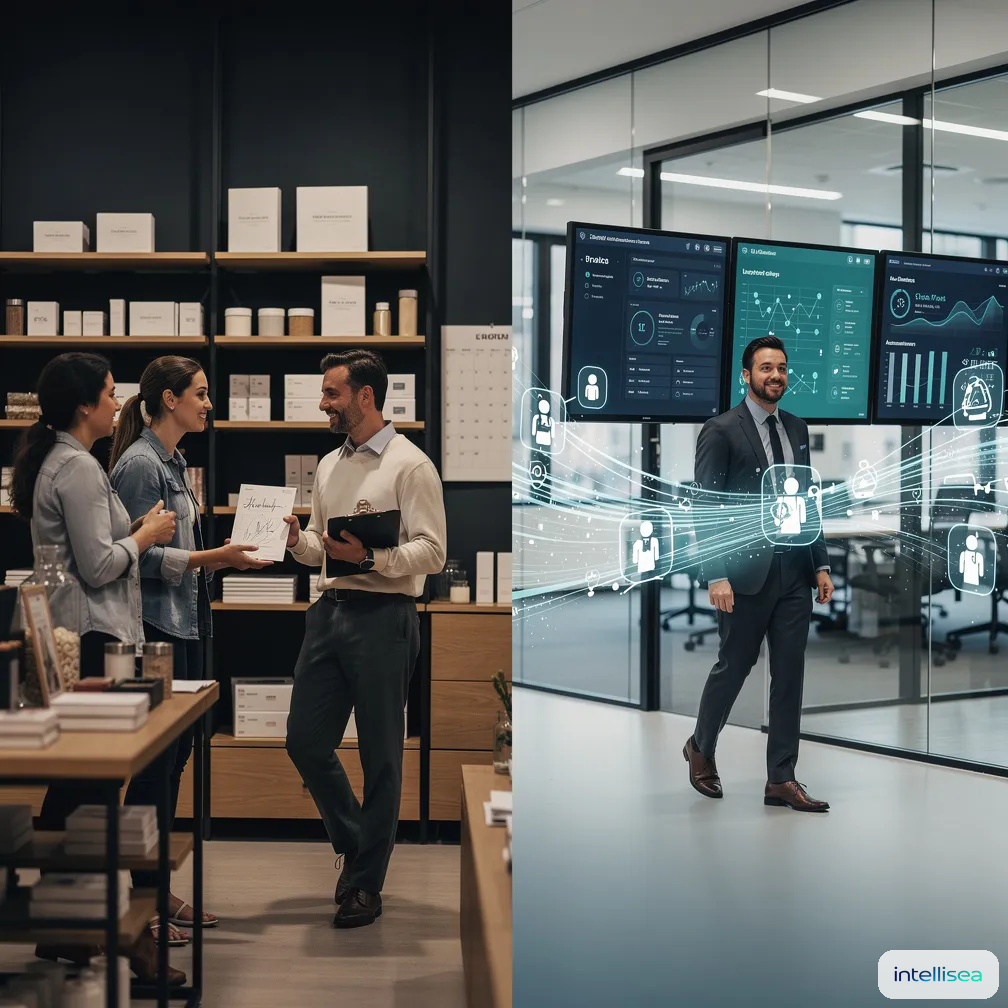
The landscape of agency marketing has undergone a fundamental transformation. Business owners and marketing directors evaluating partners today face a dramatically different environment than even a few years ago. The traditional agency model — built on retainers, manual processes, and gut-driven decisions — is giving way to something far more capable. Modern marketing agency strategies now leverage artificial intelligence, real-time data, and autonomous execution systems that deliver measurable results at unprecedented speed and scale.
For companies seeking a full service marketing agency, understanding this evolution is essential. The right agency partner accelerates growth, optimizes spend, and provides competitive advantages that manual approaches cannot match. The wrong one drains budgets while delivering underwhelming results wrapped in impressive-sounding reports.
Agency Marketing, Defined
Agency marketing is the practice of specialized external firms providing strategy, technology, and execution to help businesses reach their growth objectives. It encompasses everything from brand strategy and content creation to paid advertising, SEO, and analytics — all increasingly powered by AI systems that optimize performance continuously rather than on a quarterly review cycle.
This definition has expanded considerably. Today's agency marketing approach integrates multiple disciplines, channels, and technologies into cohesive strategies that adapt based on performance data. The agencies that deliver the strongest results are the ones whose operational model reflects this reality — not the ones who simply added a few AI tools to the same retainer structure they ran five years ago.
How Agency Marketing Has Evolved
Understanding where agency marketing has been helps contextualize where it's heading. The evolution has progressed through four distinct phases:
The Creative Era focused on brand messaging, print, and broadcast. Agencies sold concepts and production. Success was subjective and difficult to measure.
The Digital Transition brought websites, email, and early SEO. Agencies added digital specialists but often kept traditional and digital teams siloed. Measurement improved but remained limited.
The Data-Driven Phase emerged with sophisticated analytics platforms and marketing automation. Agencies began competing on their ability to interpret data and optimize campaigns based on performance metrics.
The AI-Native Model represents the current frontier. Advanced agencies now deploy artificial intelligence not just for analytics, but for autonomous decision-making, content generation, predictive modeling, and real-time optimization across all channels simultaneously. This is a fundamentally different category — not just traditional agencies using AI tools, but agencies architecturally built around autonomous AI agents that execute strategy around the clock.
This evolution matters because it directly impacts what results an agency can deliver. An agency still running 2020 processes cannot compete with one leveraging 2026 capabilities — regardless of team size or creative awards.
What Clients Should Expect From a Modern Agency
When evaluating agency partners, business leaders should set expectations based on contemporary capabilities, not legacy models.
Integrated Multi-Channel Execution. A sophisticated marketing agency strategy doesn't treat channels as silos. Coordinated campaigns across paid search, social, content, and email — with cross-channel data informing every decision — should be the baseline, not a premium offering.
Technology-Enabled Execution. The best agencies invest in AI-powered platforms and proprietary systems that enhance human expertise while dramatically improving execution speed and optimization accuracy.
Transparent Reporting. Real-time dashboards connecting marketing activities directly to business outcomes — qualified leads, acquisition costs, revenue impact. Not monthly PDF decks with vanity metrics.
Agile Methodology. Rapid testing, continuous optimization, and flexible resource allocation based on what's working — not rigid annual plans that are outdated before Q2.
Strategic Partnership. The best agency relationships transcend vendor-client dynamics. Modern agencies deeply understand your business model, competitive landscape, and growth objectives, then align their efforts accordingly. If you're evaluating local options, our guide on how to find an advertising agency near you covers what to prioritize in that search.
The AI Agent Model vs. the Traditional Retainer
The most significant shift in how agencies do marketing involves the operational model itself. The traditional retainer allocates fixed resources — specific team members working set hours on your account. This approach has inherent limitations in scalability, flexibility, and efficiency.
The emerging agentic AI model reimagines this structure entirely. Rather than human teams manually executing every task, AI agents handle routine optimization, data analysis, content variations, bid management, and performance monitoring autonomously. Human expertise focuses on strategy, creative direction, and complex decisions that require business context.
This hybrid approach delivers clear advantages:
- Scalability without proportional cost: AI agents monitor and optimize hundreds of campaigns simultaneously without additional headcount
- 24/7 optimization: Autonomous systems adjust campaigns continuously, not just during business hours
- Faster execution: Changes implemented in minutes rather than days
- Data-driven consistency: Decisions based on comprehensive analysis, not individual interpretation
- Higher-value human contribution: Strategists focus on the work that drives differentiation, not the tasks a machine handles better
For an agentic AI marketing agency like Intellisea, this means clients get both AI-powered execution and strategic human expertise — without the bloated team structures that inflate traditional agency costs.
Performance Metrics That Actually Matter
Modern agency marketing demands accountability to metrics tied directly to business outcomes. When evaluating performance, these indicators reveal the truth:
Customer Acquisition Cost (CAC): What does it actually cost to acquire a customer through agency-managed channels? This cuts through vanity numbers to reveal efficiency.
Marketing-Qualified and Sales-Qualified Leads: Not traffic or impressions — prospects who meet defined criteria indicating genuine purchase intent.
Conversion Rate at Each Funnel Stage: Measurable improvements in how effectively your assets move prospects forward.
Return on Ad Spend (ROAS): For paid campaigns, revenue generated per dollar spent provides clear performance visibility.
Speed to Results: How quickly does the agency identify opportunities, implement changes, and generate measurable improvements? AI-powered agencies compress this timeline significantly.
Advanced agencies provide real-time dashboards, not monthly reports that are outdated before delivery.
Intellisea's Agentic Approach to Agency Marketing
Intellisea's agency marketing approach exemplifies the evolution toward AI-powered execution. By deploying autonomous AI agents alongside experienced strategists, Intellisea delivers the comprehensive capabilities of a full-service agency with the efficiency and speed of advanced technology.
The AI-powered marketing services methodology combines autonomous optimization across paid media, content deployment, SEO, and analytics with human expertise in strategy, creative direction, and business alignment. Clients don't choose between technology and expertise — they get both, working in a continuous loop.
Whether you're evaluating national partners or local agencies, understanding the agentic model helps you identify agencies positioned to deliver 2026 results rather than 2020 approaches with updated terminology.
Frequently Asked Questions
What is agency marketing?
Agency marketing is the practice of external marketing firms providing specialized strategy, technology, and execution to help businesses achieve growth objectives. In 2026, this increasingly includes AI-powered optimization, autonomous campaign management, and real-time analytics alongside traditional strategic and creative services.
How much does agency marketing cost?
Costs vary based on scope, industry, and agency model. Traditional full-service agencies typically require significant monthly retainers to cover large team structures. AI-powered agencies can often deliver comparable or better results more efficiently because technology handles execution tasks that would otherwise require additional personnel.
What's the difference between a traditional and AI-powered agency?
Traditional agencies rely primarily on human teams for execution, optimization, and analysis — which limits scalability and speed. AI-powered agencies deploy autonomous agents to handle routine optimization and data analysis continuously, while human experts focus on strategy, creative direction, and complex decision-making that requires business judgment.
How do marketing agencies measure success?
Quality agencies measure success through business-outcome metrics: customer acquisition cost, qualified lead volume, conversion rates, return on ad spend, and revenue impact. Agencies still reporting primarily on impressions, reach, or follower counts are using outdated measurement frameworks.
Is agency marketing worth it for small businesses?
Yes — particularly with AI-powered agencies that deliver enterprise-level execution at accessible price points. The agentic model reduces the overhead that traditionally made full-service agencies cost-prohibitive for smaller companies, while still providing strategic expertise and multi-channel capabilities.
Ready to Experience Agency Marketing That Runs 24/7?
The performance gap between agencies leveraging modern AI capabilities and those relying on traditional approaches continues to widen. For companies serious about growth, partnering with an agency that combines technological sophistication with strategic expertise isn't optional — it's competitive necessity.